
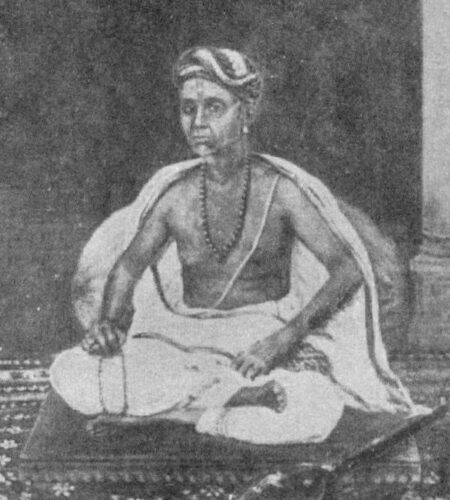
Life & Legacy
Born in 1767 in Tiruvarur and settled in Thiruvaiyaru on the banks of the Kaveri, Tyagaraja (Kakarla Tyagabrahmam) turned down wealth and royal patronage to live as Rama''s singer. When the king of Thanjavur summoned him with gifts, his reply became one of his most famous songs: "Nidhi chala sukhama?" — "Does wealth bring happiness, or does nearness to Rama?" He lived by unchavritti, walking the streets each day singing the divine name and accepting whatever alms came, and he is said to have composed tens of thousands of songs, of which around 700 survive — almost all in Telugu, each fixed to a raga with a craftsmanship that made him, with Muthuswami Dikshitar and Syama Sastri, one of the "Trinity" of Carnatic music.
Alongside the concert kritis, Tyagaraja composed music meant explicitly for congregational singing: his divya nama sankirtanas ("songs of the divine name") and utsava sampradaya songs for festival worship are simple, repeating, and made for group voices — the South Indian counterpart of the kirtan spirit. Every January, on the anniversary of his passing, thousands of musicians gather at his samadhi in Thiruvaiyaru for the Tyagaraja Aradhana and sing his five Pancharatna ("five gems") kritis in unison — one of the largest acts of collective sacred song in the world.