
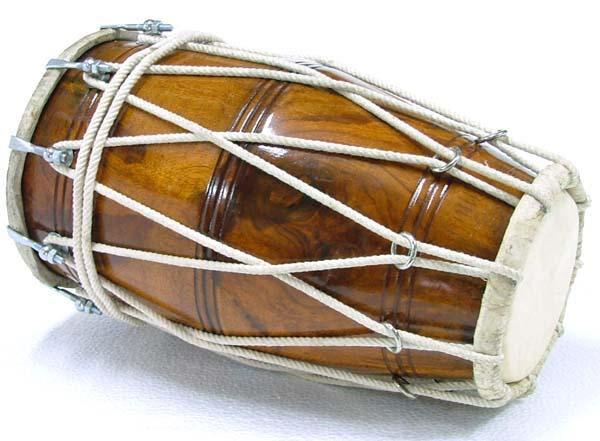
See & Hear the Dholak
About the Dholak
The dholak is a two-headed, barrel-shaped folk drum played with both hands. One head produces a high, tight slap and the other a deep bass, and the two are linked by rope or metal tensioners. Lighter and more relaxed than the tabla, it is the everyday drum of folk songs, weddings, and group bhajan, and it brings an earthy, celebratory swing to Kirtan. Its simplicity makes it a welcoming entry point for newcomers who want to keep the beat.
Its Role in Kirtan
The dholak is the people's drum of devotional singing. Long before Kirtan reached concert halls it lived in village satsangs, temple courtyards, and family gatherings, and there the dholak — cheap, sturdy, and playable without formal training — kept the songs moving. It remains the everyday heartbeat of group bhajan across North India, especially in women's singing circles, where one drummer's steady keherwa groove supports dozens of clapping, singing participants. In a Kirtan ensemble it plays a different role than the tabla: less intricate, more infectious, favoring a driving folk swing that invites bodies to move. Western Kirtan bands often reach for it when a chant calls for celebration rather than subtlety, and many gatherings keep one on hand precisely because a newcomer can pick up the basic pulse in minutes and immediately belong to the rhythm.
Mantras Sung with the Dholak
Chants traditionally accompanied by the dholak in kirtan and practice.
Play Mantras on the Dholak
These chants have verified chord charts with a dholak-ready view — pick a key, follow the chart, and lead.
Raghupati Raghava Raja Ram
Chord chart with guitar & harmonium views
Sita Ram
Chord chart with guitar & harmonium views
Jaya Siya Ram
Chord chart with guitar & harmonium views
Want the full songbook? Browse every mantra with a chord chart →
Hear It in Practice
Terms in the Glossary
Words from this page, explained in our A–Z reference.
Keep Exploring