
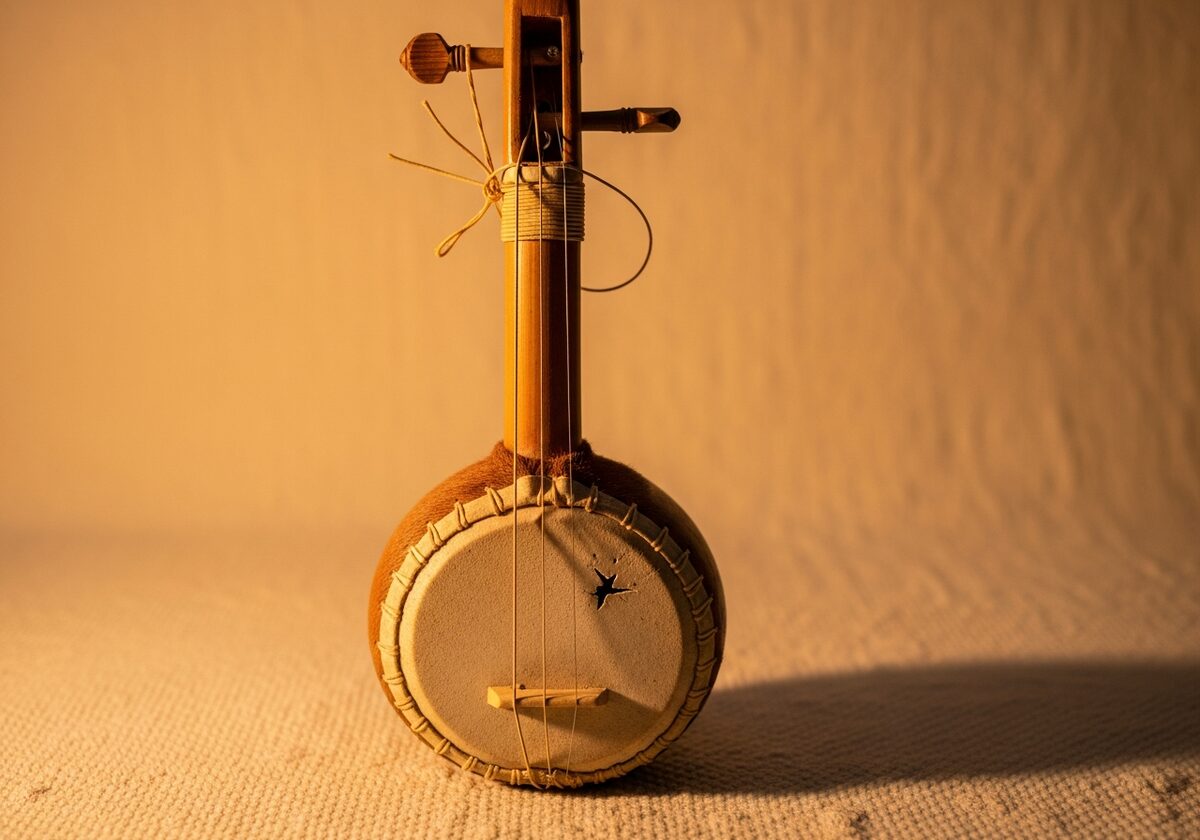
See & Hear the Ektara
About the Ektara
The ektara ('one string') is among the simplest of instruments: a single string stretched over a gourd or wooden resonator, plucked with one finger to sound a single droning note. Squeezing the split bamboo neck bends the pitch, giving it its characteristic 'boing'. It is the iconic instrument of the Bauls — the wandering mystic minstrels of Bengal — and of folk devotional singing across India. More a folk and solo instrument than a group-Kirtan staple, its humble, hypnotic drone embodies the Bhakti spirit of devotion stripped to its essence.
Its Role in Kirtan
The ektara belongs to Kirtan's oldest image: the lone singer walking from village to village with a one-stringed instrument and a song of longing for the Divine. It is inseparable from the Bauls, Bengal's wandering mystic minstrels, who pluck its single drone while they sing and spin — one hand on the ektara, the whole body in the music. Its one string carries an easy symbolism that Bhakti tradition has always loved: one note, one name, one-pointed devotion. In group Kirtan the ektara is rarely the engine of the ensemble; its role is intimate rather than congregational, suited to solo chant, storytelling, and the quieter opening moments of a gathering. Western audiences most often meet it through singers in the Baul and sadhu lineage — Bhagavan Das, an early bridge of chant to the West, made its hypnotic twang part of his signature sound.
Mantras Sung with the Ektara
Chants traditionally accompanied by the ektara in kirtan and practice.
Play Mantras on the Ektara
These chants have verified chord charts with a ektara-ready view — pick a key, follow the chart, and lead.
Om Namah Shivaya
Chord chart with guitar & harmonium views
Hare Krishna Maha Mantra
Chord chart with guitar & harmonium views
Nitai Gauranga
Chord chart with guitar & harmonium views
Want the full songbook? Browse every mantra with a chord chart →
Hear It in Practice

Terms in the Glossary
Words from this page, explained in our A–Z reference.
Keep Exploring