
Meaning & Translation
Transliteration
Om A-mi De-wa Hrih
Pronunciation
ohm ah-mee DAY-wah hree
Deity / Quality Invoked
Amitabha Buddha
Full Translation
Om Ami Dewa Hrih is the Tibetan form of the mantra of Amitabha, the Buddha of Infinite Light, whose Pure Land (Dewachen) is open to all who turn toward him with faith. Hrih is Amitabha's seed syllable — the sound-essence of compassionate, boundless light.
Spiritual Significance
Amitabha practice is the practice of trust in limitless compassion: reciting his mantra is said to purify the causes of fear, ripen rebirth in his Pure Land, and — in life — open the heart's capacity for warmth without measure. In East Asia the same devotion takes the form of the spoken homage "Namo Amitabha" (nianfo).
Cultural Context & History
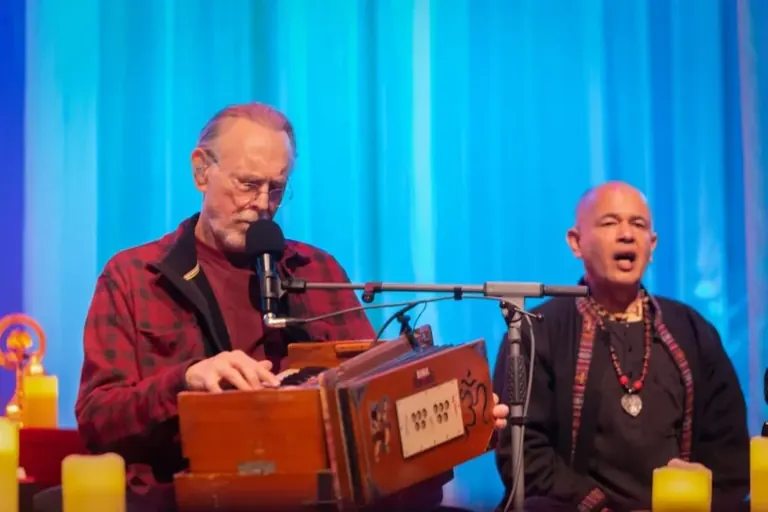
Devotion to Amitabha spans the whole Mahayana world, from Tibetan Dewachen prayers to Chinese and Japanese Pure Land recitation. Krishna Das learned the Amitabha mantra in the Tibetan tradition and has recorded it ("Amitabha Mantra," 2022) and sung it at gatherings like Bhakti Fest, bringing this Buddhist practice into his kirtan repertoire.
For Leaders
Chords and structure for leading this chant on harmonium or guitar — transcribed from the linked recording. New to leading? Read our guide to leading kirtan →
Original key
Cm
Tempo & feel
Slow rolling meditation (~58 bpm); wide, unhurried phrases with space between repetitions
Chord Chart
Strumming & rhythm (4/4)
D = downstrum, U = upstrum, · = let it ring. slow rolling: one deep downstrum, one soft up mid-bar; let everything ring.
Call & response (identical)
Call & Response Structure
Four syllables of mantra over a dark Cm home. The first line lifts through Ab–Bb before falling back; the second line's F major is the dorian surprise — a moment of light inside the minor — before Hrih settles home on Cm. Call and response are identical; keep every cycle soft and even, like turning a prayer wheel.
Terms in the Glossary
Words from this page, explained in our A–Z reference.