
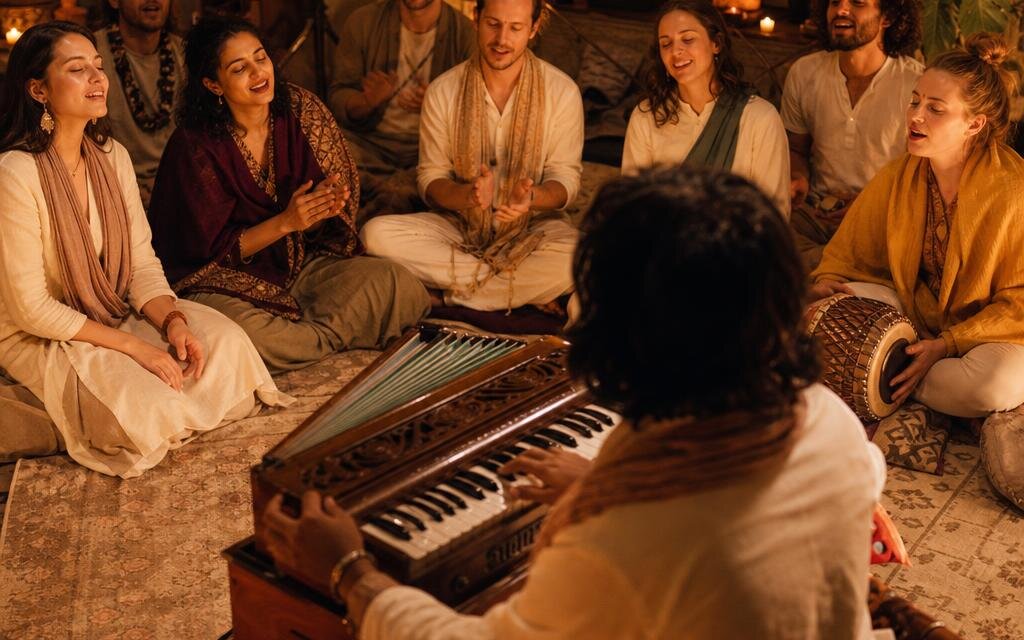
How to Lead Kirtan: Structure, Harmonium Basics, and Building a Set
Sooner or later, many chanters feel the pull from the circle's edge to its center. Leading kirtan is not a performance — it is closer to hosting: you hold the door open and the room walks through it. This guide covers the three practical skills every new leader needs — structure, an instrument to lean on, and a set that has somewhere to go.
How call-and-response actually works
Kirtan's engine is simple: you sing a line (the call), and the circle sings it back (the response). But inside that simplicity live the choices that make a chant work:
- Keep the call learnable. One or two short phrases, repeated exactly, is plenty. If the circle cannot find the melody by the second round, simplify it. The Hare Krishna Maha Mantra endures partly because its melody can be caught in a single hearing.
- Repeat far longer than feels comfortable. A chant usually needs eight to ten minutes just to settle. The magic almost always happens after the point where a newcomer would have stopped.
- Shape one arc. The classic form is a slow, quiet beginning, a long gradual build in tempo and intensity, a peak where the room sings as one voice, and a deliberate descent back into silence. The silence after the last note is part of the chant — do not rush past it.
- Signal clearly. Slowing your call, dropping your volume, or lifting a hand from the keyboard all tell the circle "we are landing now." Ambiguity is the leader's only real mistake.
Each mantra with a chord chart on this site includes structure notes describing how that particular chant is traditionally shaped — see the "For leaders" section on pages like Om Namah Shivaya or Shiva Shambho.
Harmonium basics for leaders
The harmonium is the leader's instrument of choice for good reason: it drones, it breathes, and it leaves your voice free.
- Pump with the left hand, play with the right. Steady, relaxed pumping matters more than fancy playing — the bellows are the instrument's breath, and uneven air makes everything sound anxious.
- Two or three chords are enough. Most of the great circuit chants ride on two chords. Learn a minor pair (Am–G is everywhere), a major pair (C–G or G–D), and one descending line (Am–G–F–E) and you can lead for years.
- Sit on the drone. Between phrases, hold the root chord and let it ring. If your harmonium has drone stops, open the one matching your key. A shruti box or tanpura can hold the drone for you entirely.
- Choose keys for the room, not for you. Circles sing comfortably in a fairly narrow range. Every chord chart on this site transposes instantly to any key — experiment until the response sounds effortless, then remember that key.
Building a set
A kirtan set is a journey, not a playlist. A dependable 90-minute shape:
- Invocation — traditionally a Ganesha chant such as Om Gam Ganapataye Namaha: bright, simple, obstacle-clearing.
- Arrival — something slow and warm (Om Namo Bhagavate Vasudevaya sits beautifully here) to gather the room's breath.
- The long build — one or two chants that can absorb 15–20 minutes each, like Sita Ram or the Maha Mantra.
- The peak — a celebratory chant such as Govinda Jaya Jaya that can double its tempo without falling apart.
- The descent — a tender chant to Ma (Jai Ma) or a closing prayer like Lokah Samastah Sukhino Bhavantu, ending in real silence.
Alternate energies — after a driving chant, offer a spacious one. Alternate keys and moods the same way. And always know your closer before you sit down.
The practice tools page lets you filter for mantras with chord charts and assemble printable song sheets into a songbook in your set order — build your set there, print it, and the page order becomes your setlist.
Three encouragements
Your voice is good enough. Kirtan is not a vocal showcase; a sincere, steady call outshines a beautiful, uncertain one.
Start small. Lead one chant at someone else's circle before hosting your own evening. Most established leaders are glad to hand a newcomer one chant.
Serve the room. The moment leading kirtan becomes about the leader, it stops working. Watch the circle, follow its energy, and remember that the response — not the call — is the point.
Ready to Lead a Session?
The For Kirtan Leaders hub walks the whole workflow — building a setlist, printing a chart booklet, running the tempo build, and sharing the chants afterwards — with every tool linked at the right stage.
Terms in the Glossary
Words from this page, explained in our A–Z reference.
Join the Kirtans.com Community
Receive occasional updates — thoughtfully curated devotional music, upcoming gatherings, artist announcements, new resources, and inspiration to support your Bhakti practice.
Continue Reading
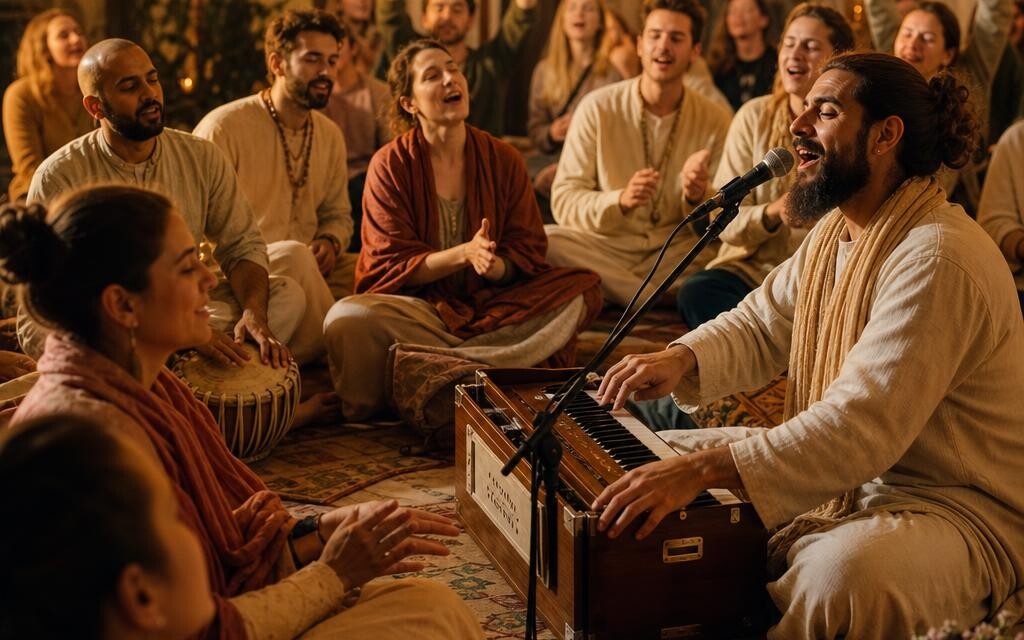
Building a Kirtan Session Arc
A kirtan session is one long breath: slow invocation, gradual build, a single true peak, and a soft landing. How to order your chants, move between keys without jolting the room, and sketch the whole arc in the setlist builder.
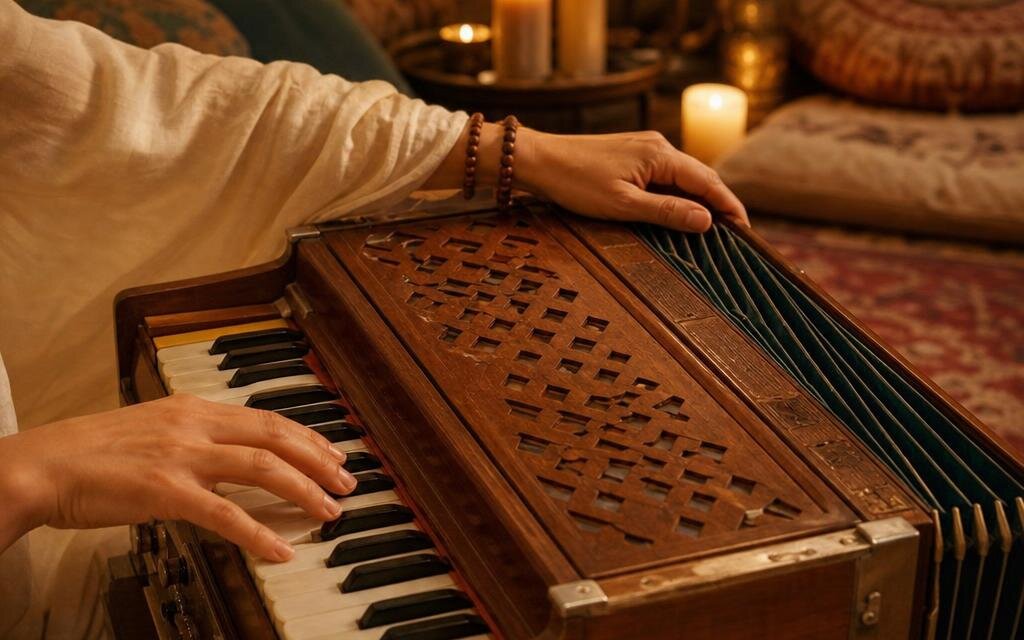
Harmonium Basics for Kirtan
The harmonium asks very little of a beginner: one hand pumps, the other plays, and a drone stop does half the work for you. This guide covers sitting down at the instrument for the first time — bellows, drone, simple right-hand voicings, and how to sing while you play.

Kirtan on Guitar
You do not need a harmonium to lead a chant. With a handful of open chords, a capo, and a soft right hand, the guitar is a beautiful kirtan instrument — portable, familiar, and gentle under a singing room. Here is how to adapt what you already know.