
Building a Kirtan Session Arc
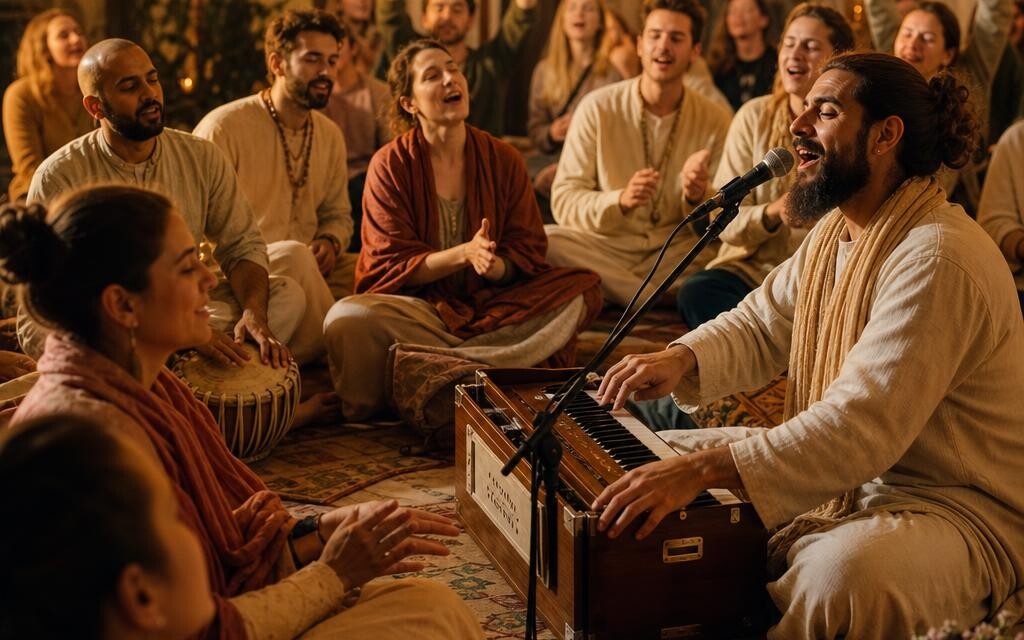
Sit in enough kirtans and you start to feel the shape underneath them. The best sessions are not a stack of songs — they are one long breath: a slow, spacious arrival, a gradual gathering of energy, a peak where the room forgets itself, and a gentle return to silence. Leaders in every lineage rediscover this same arc, because it mirrors what chanting does to a nervous system: settle, build, release, rest.
This guide is about designing that arc on purpose — how to order your chants, how to move between keys without jolting the room, and how to use the setlist builder to sketch, test, and share the whole journey.
The four movements of a session
1. Invocation — arrive slowly. Open with your slowest, most spacious chant: something breath-paced that asks nothing of the room but presence. Classic openers are invocations by nature — the Ganesh mantra clearing the way, or a slow Om Namah Shivaya. Resist the urge to start where the energy already is; the opening chant's job is to lower the room's pulse, not raise it.
2. Build — one small step at a time. Across the middle of the set, let each chant sit a little brighter or quicker than the one before. The rise should be barely perceptible chant to chant — if people notice the gear change, the step was too big. Two or three chants of gathering warmth is usually enough for a ninety-minute session.
3. Peak — one chant, fully spent. Every set needs a summit: the driving, celebratory chant where the room sings at full voice — a Hare Krishna Maha Mantra that keeps doubling, or anything with dance in it. Place it about two-thirds of the way through, and give it time. One true peak is worth more than three half-peaks.
4. Resolve — land somewhere soft. After the summit, don't simply stop. Close with something slow and tender — a lullaby-paced chant, or a final round of the opening mantra — and let the last repetition fade rather than end. The silence that follows is part of the set; hold it longer than feels comfortable. The closing chant is what the room takes home.
Key flow: the invisible glue
There is a second arc running underneath the energy arc: the harmonic one. Two chants in the same key, or in closely related keys, feel continuous — the drone barely moves, and voices carry straight from one chant into the next. Two chants in distant keys force everyone to re-anchor, and the seam shows.
The practical rule comes from the circle of fifths. A key and its neighbors — G and D, G and C — share almost all their notes, and a minor key and its relative major (E minor and G) share all of them. Moving between any of these feels seamless. Two steps out (G to A) is noticeable but easy to bridge with a breath or a short spoken interlude. Three or more steps (G to E-flat) is a genuine jump: save it for a moment where you want a scene change, and give the room a beat of silence to reset.
You don't have to compute any of this by hand. The setlist builder reads the verified key of every chart in your set — including any transposition you've chosen per chant — and marks each transition as smooth, one-step, or jarring. When a seam looks rough, you have three tools: reorder the chants, transpose one of them a step closer (every chart transposes instantly, and the easiest-key hint will keep it playable), or simply plan to pause and speak there. A jarring transition with a story in front of it stops being jarring.
Sketch it, test it, share it
Build the arc before the night, not during it. Add chants to your setlist from any chord chart in the mantra library, then use Suggest order to see how the arc logic would sequence them — it proposes a slow opener, a rising build, and a soft close while keeping neighboring keys friendly. Treat the suggestion as a first draft: your knowledge of the room always outranks the math, and your list never changes unless you apply it.
Every chart also carries a curated tempo and feel note — glance at them while you sequence, and you'll see the arc in numbers: forties and fifties at the edges, eighties in the middle, over a hundred at the peak. When the order feels right, lead the session straight from the builder, print the booklet for your musicians, or send the share link so the circle can revisit the chants at home.
When to break the arc
The arc is a map, not a law. Some nights the room arrives already lit, and opening slow would fight the current — start one movement in. Some traditions build a whole evening around a single chant, and the arc lives inside its repetitions instead: each round a little faster, a little fuller, then the long deceleration home. And an experienced leader sometimes places a deliberate jolt — a distant key, a sudden hush — exactly because the room has settled too comfortably. Learn the shape first; then you'll know when breaking it is the point.
If you're newer to leading, start with How to Lead Kirtan for the craft of holding a single chant, and walk the For Kirtan Leaders path end to end — the session arc is the step that turns a handful of chants you can lead into an evening people remember.
Terms in the Glossary
Words from this page, explained in our A–Z reference.
Join the Kirtans.com Community
Receive occasional updates — thoughtfully curated devotional music, upcoming gatherings, artist announcements, new resources, and inspiration to support your Bhakti practice.
Continue Reading
Harmonium Basics for Kirtan
The harmonium asks very little of a beginner: one hand pumps, the other plays, and a drone stop does half the work for you. This guide covers sitting down at the instrument for the first time — bellows, drone, simple right-hand voicings, and how to sing while you play.

Kirtan on Guitar
You do not need a harmonium to lead a chant. With a handful of open chords, a capo, and a soft right hand, the guitar is a beautiful kirtan instrument — portable, familiar, and gentle under a singing room. Here is how to adapt what you already know.
How to Lead Kirtan: Structure, Harmonium Basics, and Building a Set
A practical guide for anyone stepping into the leader's seat: how call-and-response actually works, what to do with your hands on the harmonium, and how to build a set that carries a room.