
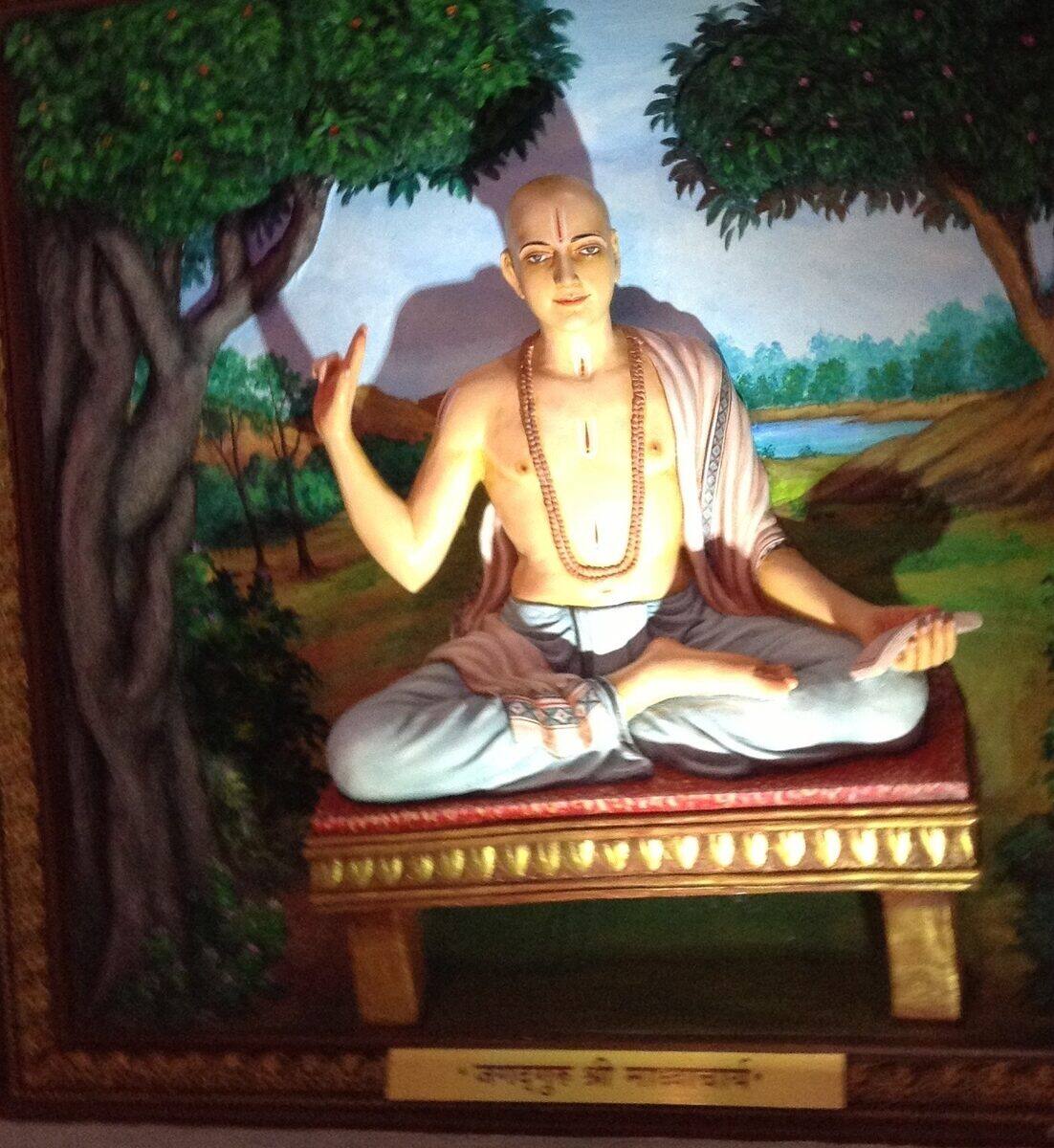
Madhvacharya
The philosopher of Udupi whose dualist Vedanta insisted the soul's highest joy is loving service of a personal God — the root from which Karnataka's singing Haridasa movement, and centuries of Krishna devotion, would grow.
Life & Legacy
Born in 1238 at Pajaka, a village near Udupi on India's southwestern coast, Madhvacharya — also known as Purnaprajna and Anandatirtha — took sannyasa as a boy and set out to challenge the prevailing philosophy of his day. Against the non-dualist teaching that the soul and God are ultimately one, he argued for Dvaita: an eternal, real distinction between the individual soul and the Supreme Lord, in which devotion is not a provisional step but the soul's everlasting purpose.
He walked the length of India twice debating scholars, wrote commentaries on the Vedanta-sutras, the Bhagavad Gita, and the Upanishads, and in Udupi installed a deity of Krishna as a dancing child, founding the Krishna Matha and the eight monasteries that still rotate its worship today. For Madhva, philosophy and devotion were inseparable — his system exists to protect the reality of the loving relationship between devotee and Lord.
That conviction bore musical fruit. The Haridasa saints of Karnataka — wandering singers in his lineage, including Purandara Dasa, the father of Carnatic music — carried Dvaita's devotional heart into the marketplace in song. And when the Gaudiya Vaishnava line of Chaitanya Mahaprabhu traced its own philosophical ancestry, it honored Madhva as a founding link in its chain of teachers.