
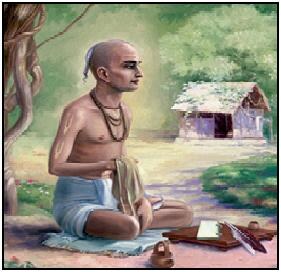
Sanatana Goswami
The prime minister who traded a sultan's court for a beggar's cloth at Chaitanya's word — elder of the Six Goswamis, author of the Gaudiya tradition's devotional lawbook, and first architect of Vrindavan's temple worship.
Life & Legacy
Sanatana Goswami was born around 1488 into a learned Brahmin family and rose, with his younger brother Rupa, to the highest offices in the court of Sultan Alauddin Hussain Shah of Bengal, where he served under the name Sakara Mallika. When Chaitanya Mahaprabhu passed through Bengal igniting the sankirtana movement, both brothers resolved to abandon power and wealth for the path of devotion. Sanatana was imprisoned to prevent his leaving; he bribed his jailer, escaped, and walked to meet Chaitanya, who spent two months instructing him in the science of Bhakti at Varanasi.
Sent to Vrindavan, Sanatana spent the rest of his life uncovering the lost sites of Krishna's pastimes and building the devotional culture of the town that would become the world's kirtan heartland. He established the worship of the Madan Mohan deity — the first of Vrindavan's great Gaudiya temples — living all the while as a mendicant under a different tree each night.
His writings gave the movement its foundations: the Brihad-bhagavatamrita, a pilgrim's map of the devotional universe told as a saint's search for the greatest devotee, and the Hari-bhakti-vilasa, the tradition's manual of devotional practice and temple worship. With Rupa, he turned Chaitanya's ecstasy into a civilization.