
Meaning & Translation
Sanskrit
देवकीनन्दन गोपाल
Transliteration
Devakinandana Gopala
Pronunciation
day-vah-kee-NAHN-dah-nah go-PAH-lah — flowing and unhurried, the names melting into one another
Deity / Quality Invoked
Krishna
Full Translation
Two names of Krishna woven into one flowing chant: Devakinandana, "the joy of Devaki" — the divine child born to his imprisoned mother against all odds — and Gopala, "protector of the cows," the playful cowherd boy of Vrindavan. Together they hold both the miracle of Krishna's birth and the sweetness of his childhood, inviting the singer into an intimate, familial love of the divine.
Spiritual Significance
This chant is a staple of namasankirtana — the practice of singing the divine names — sung for centuries across India's devotional traditions and cherished in the repertoires of saints and wandering kirtan singers. Its simple two-name refrain makes it endlessly expandable: leaders layer melody upon melody as the chant builds, which is exactly why it has become a mainstay of the Western kirtan circuit.
Cultural Context & History
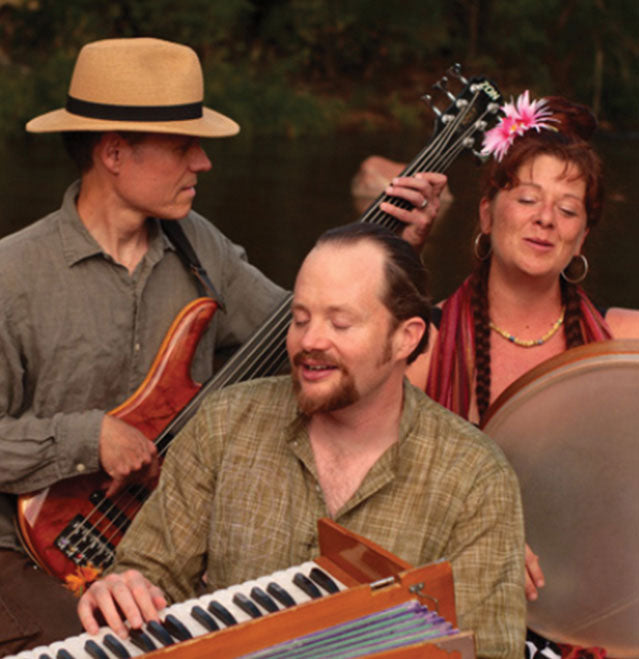
Sean Johnson & The Wild Lotus Band recorded "Devakinandana Gopala (Love)" on Unity, their ambitious triple album whose three discs — Grit, Grace, and Love — trace the full arc of devotional feeling. The New Orleans trio's signature blend of bhakti chant with swampy Southern rock and soul gives this ancient refrain an unmistakably American groove.
For Leaders
Chords and structure for leading this chant on harmonium or guitar — transcribed from the linked recording. New to leading? Read our guide to leading kirtan →
Original key
Bm
Tempo & feel
Mid-tempo soulful groove (~100 bpm) with a laid-back New Orleans backbeat
Chord Chart
Strumming & rhythm (4/4)
D = downstrum, U = upstrum, · = let it ring. laid-back groove: lean on the 2 and 4 ups for the backbeat feel.
Call
Response
Call & Response Structure
Two names, two lines, one shared melody for call and response. The D major on the first "Gopala" is the warm lift; the F#m start of the second line pulls it back into the Bm undertow. For the big final rounds the band sharpens F#m to F# major — a gospel-style dominant that makes the last return to Bm hit hard.
Terms in the Glossary
Words from this page, explained in our A–Z reference.