
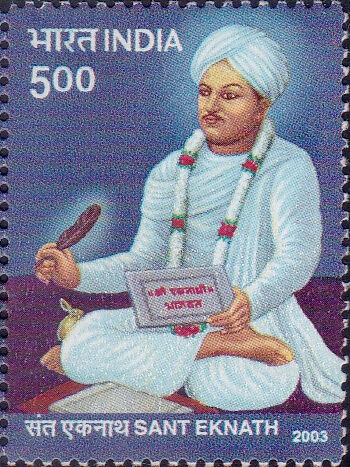
Eknath
The householder-saint of Paithan who carried the Varkari song tradition across its darkest century — restoring the Dnyaneshwari, writing the Eknathi Bhagwat, and folding street-theater songs called bharuds into the art of kirtan.
Life & Legacy
Eknath was born in 1533 at Paithan on the Godavari river, into a family already sanctified by devotion — his great-grandfather was the saint Bhanudas, who by tradition brought the image of Vitthal back to Pandharpur. Orphaned young and raised by his grandparents, he left as a boy to serve the scholar-mystic Janardana Swami at Devagiri, returning to live his whole life as that rarest of figures: a full householder who was also a full saint, feeding guests daily, scandalizing the orthodox by dining with those branded untouchable, and answering every provocation — the legends are many — with unbroken patience.
His life's work was to hand the Varkari tradition forward intact. He prepared the first critical restoration of the Dnyaneshwari, Dnyaneshwar's beloved Marathi Gita commentary whose text had decayed over 250 years; his own Eknathi Bhagwat rendered the eleventh book of the Bhagavata Purana into thousands of Marathi verses for people the Sanskrit excluded; and he composed hundreds of abhangs and bharuds — sly, vivid drama-songs in the voices of bards, beggars, and dancing girls that smuggled Vedanta into street performance. A renowned kirtan performer himself, Eknath stands as the essential bridge between the founding generation of Namdev and the flowering of Tukaram a generation after him.