
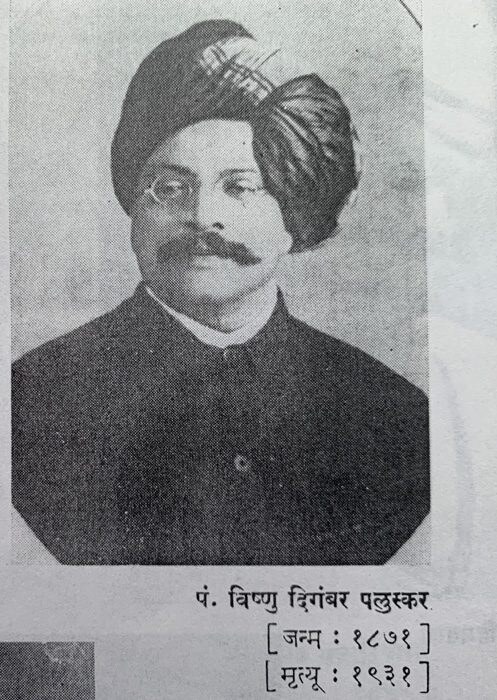
Vishnu Digambar Paluskar
The singer-reformer who carried bhajan out of the temple and onto the public concert stage — founder of the Gandharva Mahavidyalaya and the voice whose Ram dhun, "Raghupati Raghava Raja Ram," became the marching song of a nation.
Life & Legacy
Vishnu Digambar Paluskar was born in 1872 at Kurundwad, in present-day Maharashtra, into a family of kirtankars — his father sang the traditional kirtan of the region. Partially blinded in boyhood by a firecracker accident, he was sent to study vocal music in the Gwalior tradition, and emerged with a conviction that would remake Indian music: that sacred song belonged not to princely courts but to everyone. In 1901 he founded the Gandharva Mahavidyalaya in Lahore — the first music school in modern India run on public support rather than royal patronage — and dedicated his life to restoring music, above all devotional music, to social respectability.
Paluskar ended his concerts with a bhajan, a practice that helped fix the devotional close of the Hindustani recital that endures to this day. His most far-reaching act was the simplest: his melody for the Ram dhun "Raghupati Raghava Raja Ram" — the endlessly singable tune in which the world knows it — traveled from his singing into the prayer meetings of Mahatma Gandhi, who made it the marching song of the freedom movement, sung on the Salt March of 1930 and at gatherings ever since. He sang the verses of Tulsidas's Ramayana across North India, and tradition remembers that he spent his final years singing almost nothing but the name of Ram.