
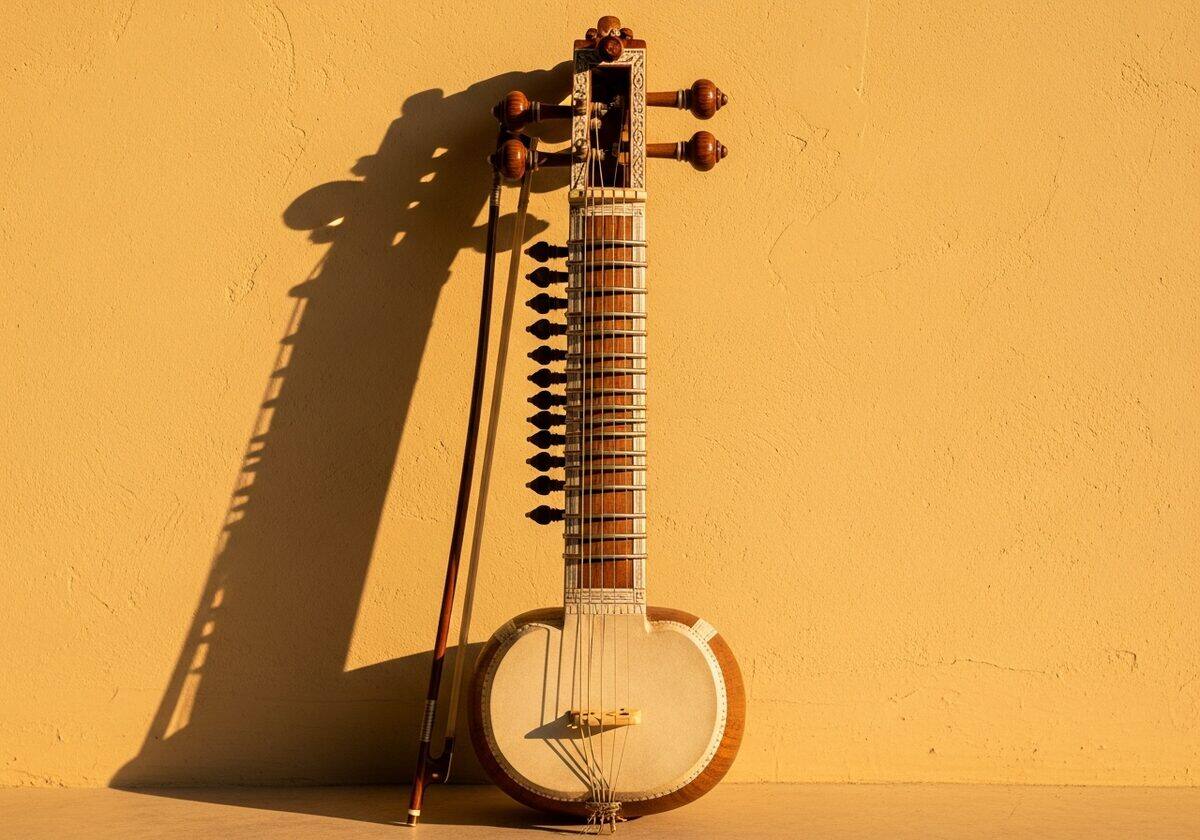
About the Dilruba
The dilruba — Persian for "heart-stealer" — is a bowed string instrument that pairs a sitar-like fretted neck with a small skin-topped body played upright with a bow (gaz). Four main strings carry the melody while a dozen or more sympathetic strings ring along untouched, wrapping every phrase in a silvery halo. Because the strings are bowed rather than plucked, the dilruba can sustain and bend notes the way a singer does, gliding between pitches with the meend that gives Indian sacred music its vocal quality. Sikh tradition attributes the instrument to Guru Gobind Singh, who is said to have re-shaped the larger taus — the peacock-bodied bowed instrument of Guru Hargobind's era whose name is Persian for "peacock" — into a lighter form his soldiers could carry on horseback. The dilruba later reached Western ears in 1967, when George Harrison featured it on The Beatles' "Within You Without You" on Sgt. Pepper's Lonely Hearts Club Band.
Its Role in Kirtan
Alongside the plucked rabab, the bowed dilruba and taus are tanti saaj — the string instruments on which Gurbani kirtan was sung for centuries before the harmonium arrived. Their sustained, voice-like tone shadows the singer's line, breathing with the shabad rather than punctuating it. Like the rabab, both instruments nearly disappeared from the gurdwara in the twentieth century, and both are returning through the tanti saaj revival, as luthiers rebuild them and a new generation of ragis bows the old sound back into worship — the dilruba favored for its portability, the taus for its deep, resonant grandeur.
See & Hear the Dilruba
Mantras Sung with the Dilruba
Chants traditionally accompanied by the dilruba in kirtan and practice.
Mool Mantar
"One Creator, whose Name is Truth — the opening verse of the Guru Granth Sahib"
Ong Namo Guru Dev Namo
"I bow to the creative wisdom; I bow to the divine teacher within."
Ra Ma Da Sa Sa Say So Hung
"The Kundalini "Siri Gaitri" mantra for healing — Sun, Moon, Earth, Infinity"
Terms in the Glossary
Words from this page, explained in our A–Z reference.
Keep Exploring

