
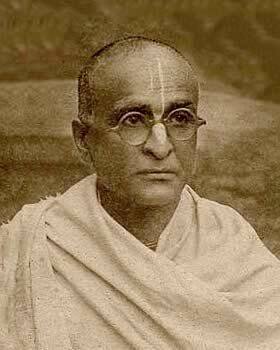
Bhaktisiddhanta Sarasvati
The scholar-monk who rebuilt Chaitanya's sankirtana movement into a modern mission of 64 centers — and whose instruction to a young Calcutta disciple to "preach in English" set the Hare Krishna mantra on its journey West.
Life & Legacy
Born Bimala Prasad in Puri in 1874, he was the son of Bhaktivinoda Thakura, the great reviver of Chaitanya Mahaprabhu''s tradition — and he inherited his father''s mission whole. A prodigy who earned the title "living encyclopedia" for his learning, he took vows of asceticism and, from 1918, organized the Gaudiya Math: a network that grew to sixty-four centers across India, with outposts as far as London and Berlin, devoted to teaching Chaitanya''s path of nama-sankirtana — the congregational chanting of the holy names — with scholarly rigor and modern means. He printed newspapers and books on machine presses, put sacred teaching on trains and gramophone records, and insisted that the chanting of the Hare Krishna maha-mantra was not folk custom but the heart of a coherent spiritual science.
In 1922, in Calcutta, a young man named Abhay Charan De came to meet him; at their first conversation, he told the future Srila Prabhupada that he should carry Chaitanya''s message to the world in English. Initiated by Bhaktisiddhanta in 1933, Prabhupada spent three decades preparing before sailing for New York — and everything that followed, from Tompkins Square Park to the worldwide spread of Hare Krishna kirtan, flowed from that instruction.