
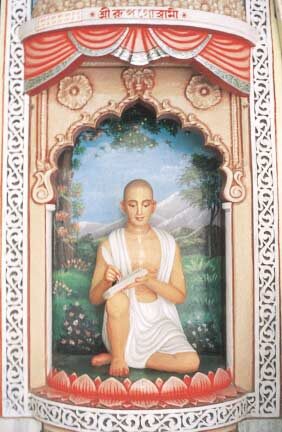
Rupa Goswami
The minister who left a sultan's court at Chaitanya's word — senior of the Six Goswamis of Vrindavan, mapper of devotion's emotional science in the Bhakti-rasamrita-sindhu, and architect of Vrindavan as the world's kirtan heartland.
Life & Legacy
Rupa Goswami and his elder brother Sanatana rose to the highest offices at the court of Sultan Alauddin Hussain Shah of Bengal — until Chaitanya Mahaprabhu passed through Ramakeli around 1514 and both brothers' lives turned on the meeting. Rupa renounced his position and wealth, met Chaitanya again at Prayaga, where tradition holds the master instructed him for ten days in the science of devotion, and was sent to Vrindavan — the forgotten land of Krishna's youth — to recover its holy places and give the new movement its theology. There he lived as a mendicant scholar under a different tree each night, and became the senior figure among the Six Goswamis, the circle of scholar-saints who made Vrindavan the devotional capital it remains.
His masterwork, the Bhakti-rasamrita-sindhu ("Ocean of the Nectar of Devotion," 1541), mapped bhakti itself — classifying the moods (rasas) of sacred love with a precision that made devotion a science as rigorous as any philosophy, from reverence to friendship to the gopis' all-surpassing sweetness celebrated in his Ujjvala-nilamani. He established the worship of Govindadeva, one of Vrindavan's great deities, and his writings define the standard by which the Gaudiya line measures itself to this day — its practitioners call themselves rupanuga, "followers of Rupa." When A.C. Bhaktivedanta Swami Prabhupada carried kirtan to New York four centuries later, the theology in his trunk of books was, at its core, Rupa Goswami's.