Shiva is the great paradox of the Hindu imagination: the wild ascetic who sits in unbroken meditation on Mount Kailash, ash-smeared and snake-garlanded — and also the loving husband of Parvati, the father of Ganesha, and the cosmic dancer whose steps create and dissolve universes. Within the classical trinity he is the "destroyer," but the tradition understands this destruction as grace: Shiva destroys illusion, ego, and everything that stands between the soul and freedom.
His mythology is vast. He drinks the poison that emerges when the gods churn the cosmic ocean, holding it in his throat — which turns blue — to save the world. He catches the descending river Ganga in his matted hair to break her fall. As Nataraja, Lord of the Dance, he dances the universe into and out of being within a ring of fire.
Shiva is also Adi Yogi — the first yogi, the source of yoga itself. For centuries, renunciates, tantrikas, and household devotees alike have approached him with the five-syllable mantra Om Namah Shivaya, "I bow to Shiva" — one of the most widely chanted mantras in any tradition, and a staple of Kirtan gatherings everywhere.
In Traditional Art
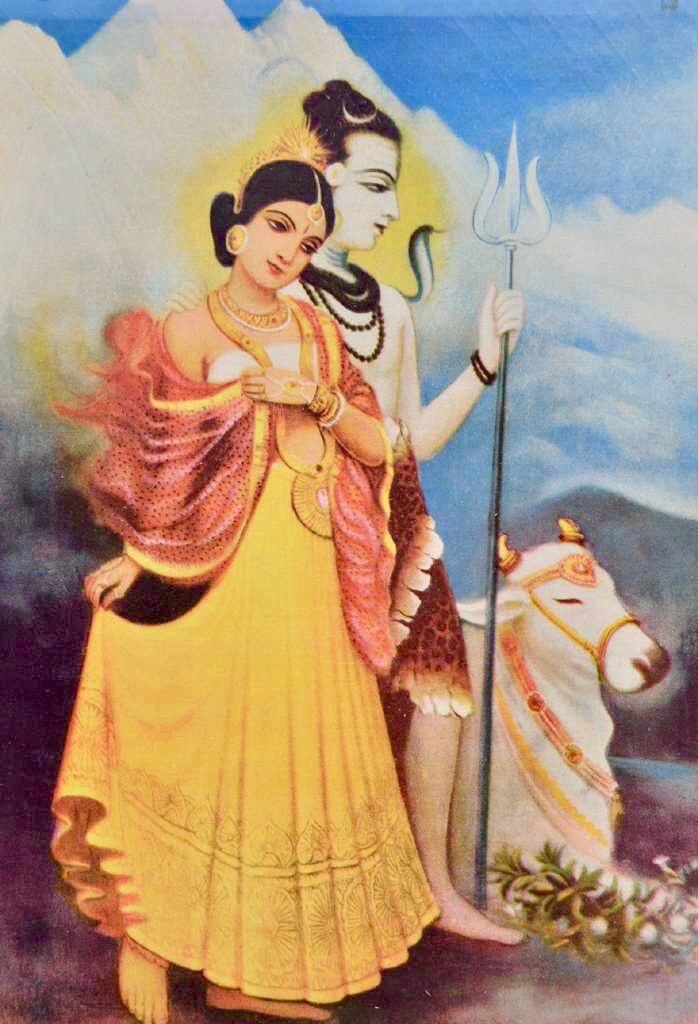
Shiva is depicted as a beautiful ascetic with matted hair piled high, a crescent moon and the river Ganga in his locks, a third eye on his forehead, a blue throat, and a cobra around his neck. He wears tiger skin, carries a trident (trishula) and the damaru drum, and is often shown with his bull Nandi, or dancing as Nataraja in a circle of flames.
In Kirtan
"Om Namah Shivaya" is one of the first mantras most Kirtan newcomers learn, and Shiva chants — "Shiva Shambho," "Hara Hara Mahadev" — bring a distinct energy to a kirtan: grounded, powerful, often building from stillness to ecstatic intensity, echoing Shiva's own nature as both meditator and dancer. The Mahamrityunjaya mantra, sung for healing and fearlessness, is also his.
Mantras Sung to Shiva
Om Namah Shivaya
"I bow to Shiva, the auspicious one within"
Mahamrityunjaya Mantra
"A healing prayer to Shiva for release from fear and death"
Shiva Shambho
"Joyful praise to Shiva, the source of bliss"
Hara Hara Mahadev
"A jubilant Sanskrit invocation to Shiva — "Hara, Hara, the Great God!""
Nataraja (Nataraja Nataraja)
"Praise to Shiva as Nataraja, the cosmic Lord of the Dance"
Om Namah Shivaya Gurave
"Honoring Shiva as the inner Guru — being, consciousness, and bliss itself"