
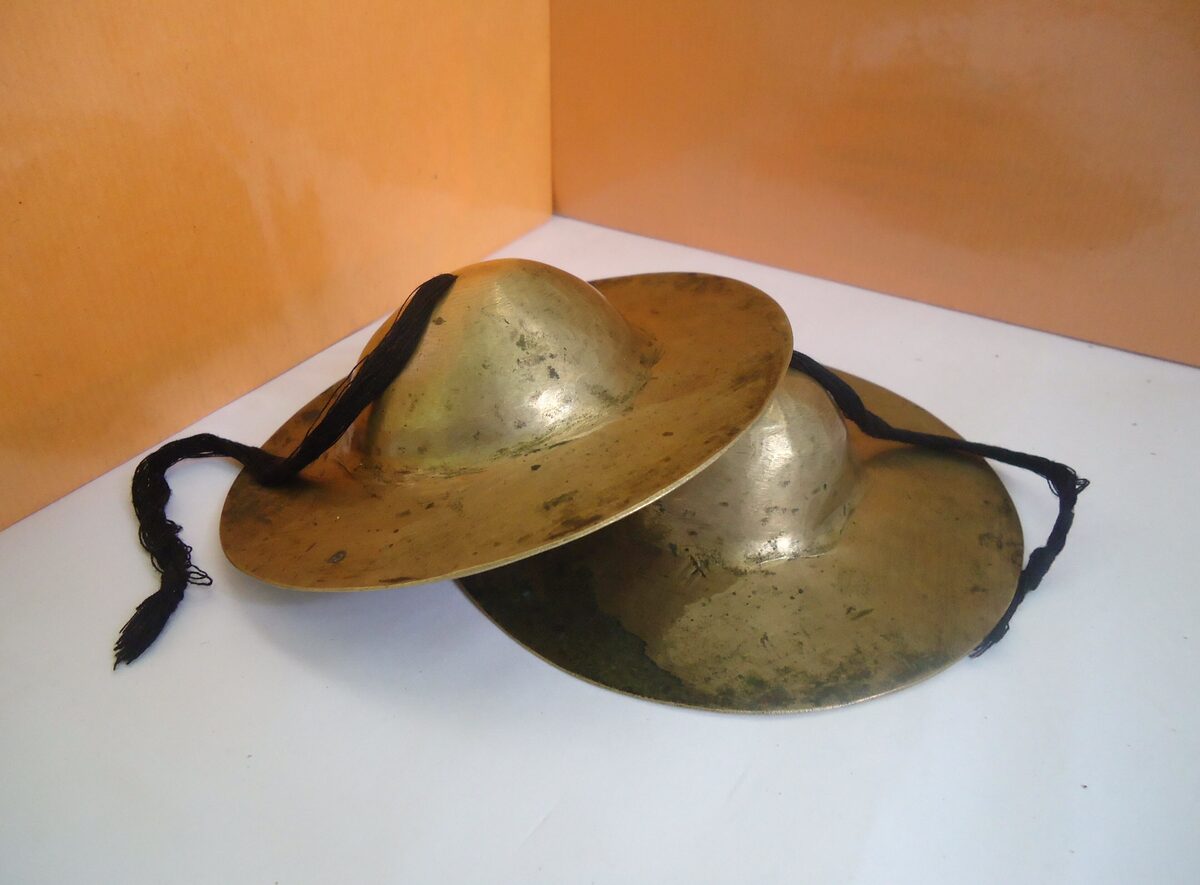
See & Hear the Kartals
About the Kartals
Kartals are hand cymbals used to mark the rhythm of Kirtan. In the Gaudiya Vaishnava tradition they are a pair of brass discs (karatals) joined by a cord and struck together to produce a bright, ringing 'ching'. A related folk form is a pair of wooden clappers fitted with small jingling discs. Easy to pick up and hard to play badly, kartals are often the first instrument a newcomer is handed at a Kirtan — a simple way to join the rhythm and feel part of the music.
Its Role in Kirtan
Kartals are the sound of participation. The name joins kara (hand) and tala (rhythm), and since the time of Chaitanya Mahaprabhu the mridanga-and-kartal pairing has been the rhythmic backbone of Gaudiya sankirtan — congregational chanting in temples and on the street. In a Hare Krishna harinama procession the lead drummers are surrounded by chanters playing kartals in simple repeating patterns, a bright metallic pulse that cuts through dozens of voices and keeps everyone locked to the same beat. That same spirit carries into Western Kirtan gatherings, where a basket of kartals is often passed around so newcomers can join the music within seconds. Playing them well is its own art — traditional patterns weave accents around the drum — but playing them at all takes no training, which is why they remain Kirtan's great equalizer between performer and audience.
Mantras Sung with the Kartals
Chants traditionally accompanied by the kartals in kirtan and practice.
Govinda Jaya Jaya
"Victory to Govinda, the tender of cows and keeper of souls"
Hare Krishna Maha Mantra
"A direct call to the divine energy of Krishna and Rama"
Jaya Radha Madhava
"A tender Gaudiya bhajan adoring Krishna as Radha's beloved, at play in the groves of Vrindavan"
Play Mantras on the Kartals
These chants have verified chord charts with a kartals-ready view — pick a key, follow the chart, and lead.
Govinda Jaya Jaya
Chord chart with guitar & harmonium views
Hare Krishna Maha Mantra
Chord chart with guitar & harmonium views
Want the full songbook? Browse every mantra with a chord chart →
Hear It in Practice

Terms in the Glossary
Words from this page, explained in our A–Z reference.
Keep Exploring