
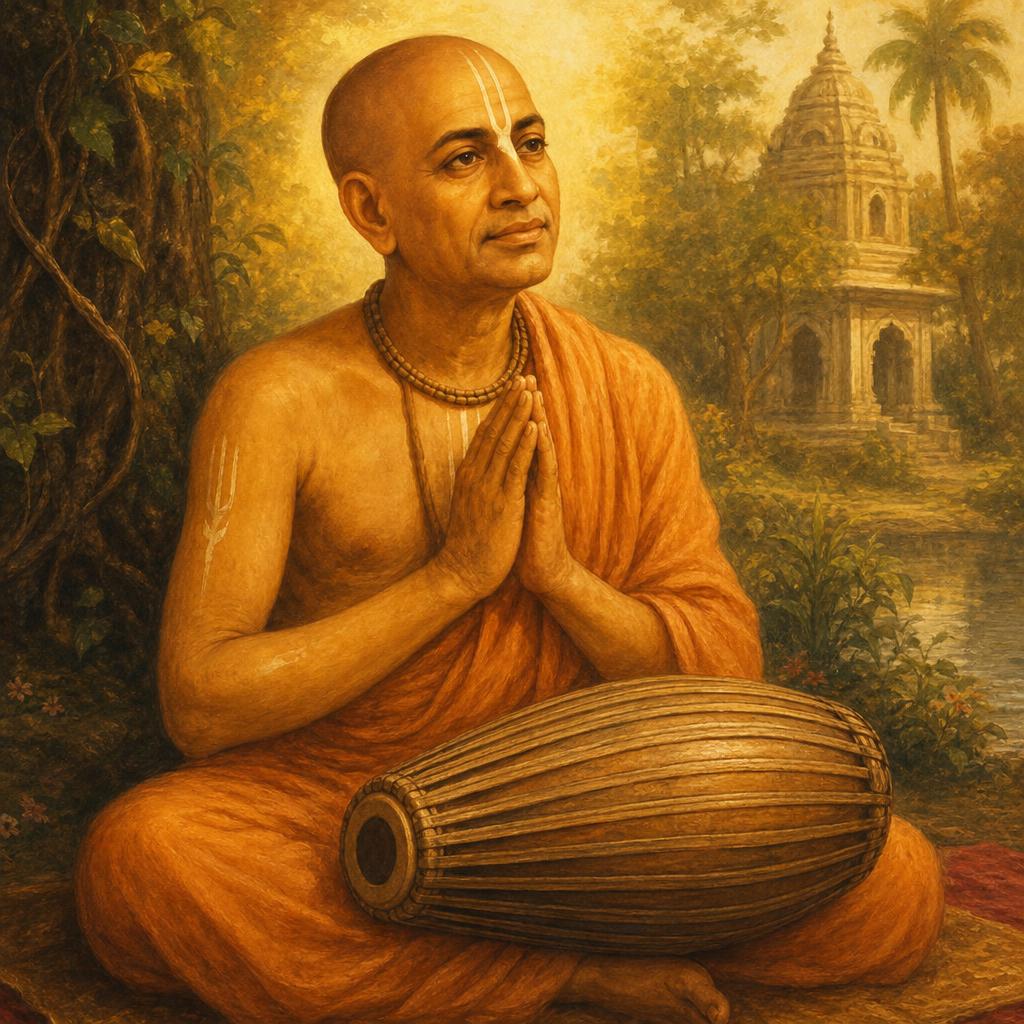
Narottama Dasa Thakura
The 16th-century Bengali saint from Kheturi — direct disciple of the Six Goswamis, organizer of the first great Gaudiya gathering, and composer of the padavali kirtans still sung throughout Bengal and Bangladesh today.
Life & Legacy
Narottama Dasa Thakura was born around 1540 into the royal family of Rajshahi (now Bangladesh), in the village of Kheturi on the banks of the Padma. From childhood he felt an overwhelming longing for the sacred town of Vrindavan and the company of Chaitanya Mahaprabhu's followers; tradition tells that Mahaprabhu himself appeared to him in a vision and directed him there.
Arriving in Vrindavan, he took initiation from Lokanatha Goswami — one of the original companions of Chaitanya Mahaprabhu — and deepened his study of the tradition's theology under Jiva Goswami, the brilliant nephew of Rupa Goswami. Together with Shyamananda Prabhu and Srinivasa Acharya he formed a trio of second-generation teachers charged with carrying the Goswamis' books and the living practice of sankirtana back to Bengal and Odisha.
His most consequential act was the Kheturi Mahotsava, the great festival he organized at his home village — the first large gathering of Chaitanya's scattered followers from across Bengal, Odisha, and Vrindavan. Days and nights of unbroken congregational singing formed the heart of the festival, and the tradition identifies it as the moment the Gaudiya community first recognized itself as a unified movement.
Narottama was also one of the tradition's most gifted composers. His padavali kirtans — devotional songs in Bengali and Braj Bhasha on the themes of longing for Nityananda, surrender to the mercy of the Vaishnavas, and the pain of separation from the divine — are composed in the Garanhati melodic style, the classical form of Gaudiya singing in Bengal. Collections including his Prarthana ("Supplication") and Prema-bhakti-chandrika ("Moonbeams of Loving Devotion") formed the core of the Bengali Vaishnava song repertoire that Bhaktivinoda Thakura would revive and carry forward in the 19th century, and that flows into the kirtans of the broader Gaudiya world today.