
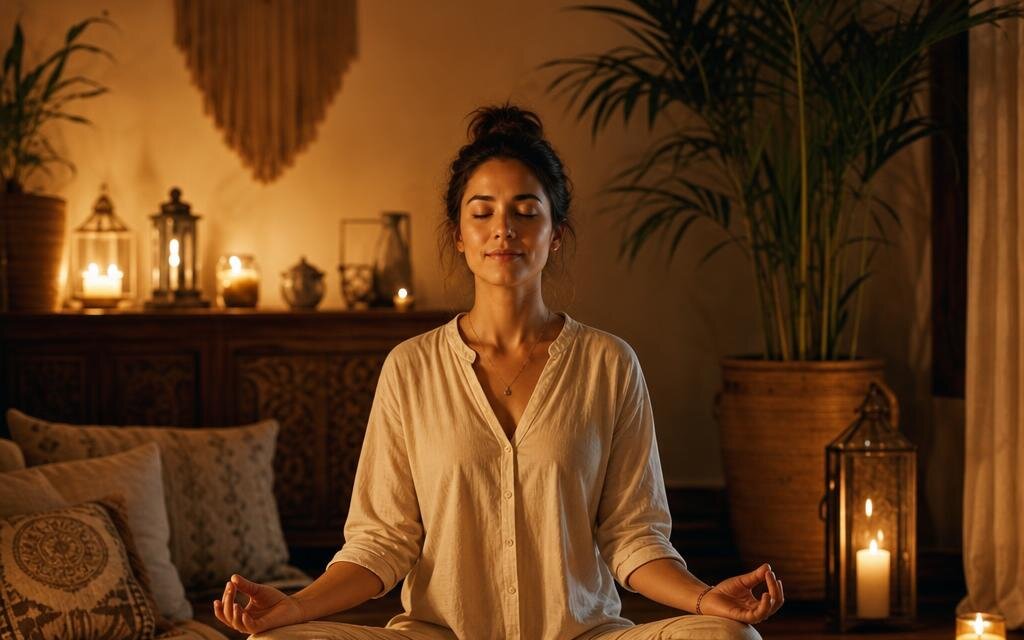
Kirtan Kriya: The 12-Minute Practice Scientists Keep Studying
Most chanting practices came to the West carried by devotion. Kirtan Kriya arrived that way too — but it stayed in the headlines because of something unusual: researchers kept studying it, and the results kept being interesting.
What Kirtan Kriya is
Kirtan Kriya is a twelve-minute meditation from the Kundalini Yoga tradition built around the mantra Sa Ta Na Ma — four syllables drawn from Sat Nam, often translated as "true identity." The practice layers three simple elements:
- Sound. You repeat Sa Ta Na Ma aloud for two minutes, in a whisper for two minutes, silently for four, in a whisper for two, and aloud again for two.
- Touch. With each syllable, you press the thumb to a different fingertip — index, middle, ring, little finger — in a steady rotation on both hands.
- Visualization. You imagine the sound flowing in through the crown of the head and out through the center of the forehead, in an "L" shape.
That is the whole practice. No special posture, no equipment, no experience required — which is exactly why it has been so easy to study.
What the research actually found
The bulk of the published work comes from the Alzheimer's Research and Prevention Foundation and from a research group at UCLA led by psychiatrist Dr. Helen Lavretsky. A few findings stand out:
Memory and cognition. In studies of older adults with age-related memory complaints, eight weeks of daily Kirtan Kriya was associated with improvements in memory and executive function, along with changes in cerebral blood flow visible on brain scans.
Caregiver stress. One of the most cited studies looked at family caregivers of dementia patients — a group under chronic, grinding stress. Practicing Kirtan Kriya twelve minutes a day for eight weeks reduced depressive symptoms and improved mental health scores more than listening to relaxing music for the same amount of time.
Cellular aging. The same caregiver study measured telomerase — an enzyme associated with cellular aging — and found significantly increased activity in the chanting group. The researchers were careful to call this preliminary, but it is a remarkable finding for a practice that takes less time than a coffee break.
Mood and inflammation. Follow-up work found reductions in inflammatory gene expression and improvements in mood and resilience scores.
The honest scientific summary: these are mostly small studies, and more replication is needed. But few contemplative practices this simple have this much published, peer-reviewed attention. If you want the broader picture of what research says about chanting in general, our guide to the healing power of chanting covers the wider field.
Why the fingertips matter
The design of Kirtan Kriya is clever from a neuroscience standpoint. The fingertip sequence occupies the motor cortex; the syllables occupy the auditory and language systems; the visualization occupies attention. There is very little bandwidth left over for rumination — the repetitive, self-critical thinking loop that stress feeds on. Traditional teachers describe the same thing differently: the mudras and mantra "lock" the mind into the practice.
This is the same principle that makes call-and-response kirtan so absorbing. As we explore in What Is Kirtan?, when the voice, the ears, and the body are all engaged in one act, the everyday mind finally has permission to be quiet.
How to try it
- Sit comfortably with a straight spine — a chair is fine.
- Chant Saaa Taaa Naaa Maaa on a simple repeated melody. Touch thumb to index finger on Sa, middle on Ta, ring on Na, little finger on Ma. Both hands, every repetition.
- Follow the voice sequence: 2 minutes aloud, 2 whispering, 4 silent (keep the fingers moving), 2 whispering, 2 aloud.
- Finish with a deep inhale, stretch the arms overhead, and exhale.
The studied "dose" is twelve minutes a day for eight weeks. You can learn the syllables and hear the pronunciation on our Sa Ta Na Ma mantra page, and if you are building a daily rhythm around it, our guide to starting a kirtan practice at home pairs naturally with it. Artists like Snatam Kaur have recorded beautiful versions of Sa Ta Na Ma if you prefer to practice along with a voice.
Twelve minutes, four syllables, five fingers. Sometimes the practices that survive centuries — and clinical trials — are the simple ones.
Terms in the Glossary
Words from this page, explained in our A–Z reference.
Join the Kirtans.com Community
Receive occasional updates — thoughtfully curated devotional music, upcoming gatherings, artist announcements, new resources, and inspiration to support your Bhakti practice.
From This Article
Continue Reading
The Science of Singing Together: Why Group Chanting Bonds a Room
Strangers walk into a kirtan; an hour later the room feels like family. Research on choirs, synchrony, and social bonding explains why singing together is one of the fastest connection technologies humans have ever found — and why kirtan is built to maximize it.
Why Chanting Calms You: The Vagus Nerve and the Long Exhale
That deep settling you feel after a few minutes of chanting is not your imagination — it is your physiology. A tour of the vagus nerve, the science of the long exhale, and why singing a mantra may soothe the nervous system faster than sitting in silence.
The Healing Power of Chanting: What Science and Tradition Both Know
For thousands of years, devotional traditions have known what modern neuroscience is now beginning to confirm: that sacred chanting has measurable effects on the brain, the nervous system, and the human heart.