
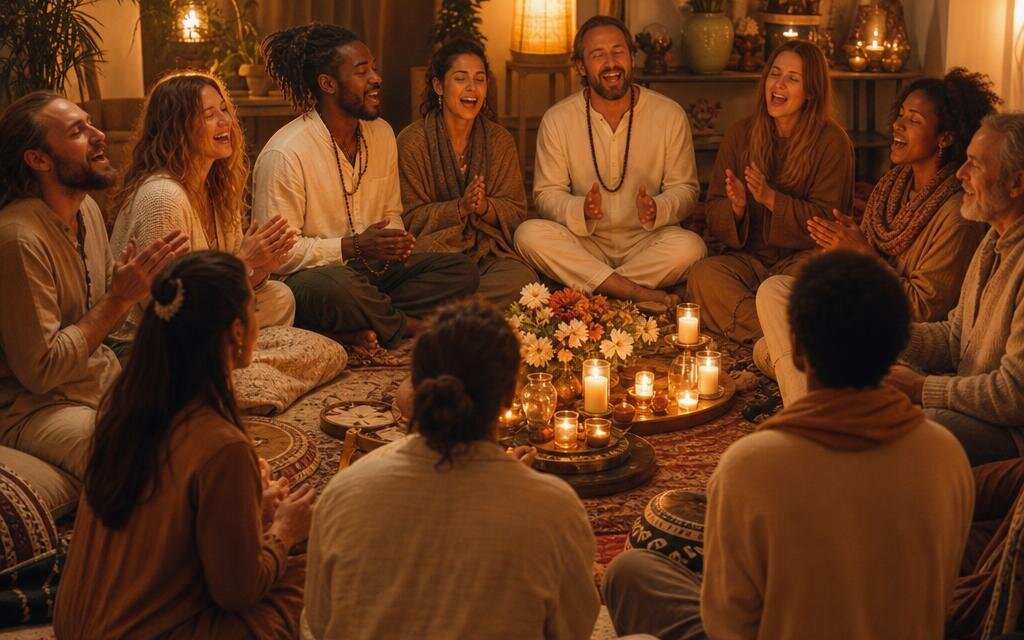
The Science of Singing Together: Why Group Chanting Bonds a Room
There is a moment in almost every kirtan when the room changes. It usually arrives without warning — somewhere in the middle of a chant, the voices lock together, and a collection of strangers becomes, briefly and unmistakably, a single thing. Regulars chase that moment for years. Scientists, it turns out, have been chasing it too.
The ice-breaker effect
Researchers studying adult education classes in the UK made a striking observation: over seven months, people in singing classes bonded with each other significantly faster than people in crafts or creative writing classes. The effect was strong enough that the researchers gave it a name — the ice-breaker effect. Singing seemed to fast-track the closeness that other group activities built slowly.
Why? The leading explanation is that group singing hits several bonding mechanisms at once:
Synchrony. Humans are wired to feel closer to people they move and sound in time with — armies march, congregations chant, fans sing in stadiums. When Swedish researchers monitored choir singers, they found that as the group sang structured phrases together, their heart rates began to rise and fall together, entrained by the shared breathing that singing imposes. Synchronized bodies, it seems, produce affiliated minds.
Neurochemistry. Group singing has been associated with elevated oxytocin — the bonding hormone — and with endorphin release, the same internal opioids behind "runner's high." Endorphin release is one of the mechanisms anthropologists believe underpins human social bonding at scale: laughter, dance, and communal song all trigger it, and all appear in every human culture ever documented.
Shared vulnerability. Singing exposes the voice — the most personal instrument there is — in front of others. Doing that together, and being accepted, is a shortcut to trust that conversation takes far longer to build.
Why kirtan is unusually good at this
Everything the research says about group singing, kirtan does deliberately — and has for centuries.
Call-and-response, the heart of the form we describe in What Is Kirtan?, is synchrony with training wheels: the leader sings the line so no one needs to know the words, and the room answers as one body. There is no audience and no performance — everyone is in the choir. The chants are short and endlessly repeated, so within minutes even a first-timer is fully inside the music rather than reading along. And the long, slow phrases impose exactly the shared breathing that entrained those Swedish choir hearts — a mechanism we unpack in Why Chanting Calms You.
Kirtan musicians know all this in their bones. Krishna Das has spent decades saying that he is not performing — that the room's voices are the practice. Jai Uttal opens his trainings by reminding people that kirtan is not about singing well but about singing together. The research would phrase it differently: reducing performance pressure and maximizing participation is precisely how you get the ice-breaker effect.
What this means for loneliness
Public-health researchers now talk about loneliness as a genuine health risk. What is striking in the group-singing literature is how consistently community choirs and singing groups show improvements in reported well-being, mood, and sense of belonging — including in populations, like older adults, where new friendships form slowly.
Chanting circles offer the same architecture with the barriers set even lower: no auditions, no sheet music, no requirement to sing well or believe anything in particular. You sit down, the leader offers a line, and you are already part of it. For the science-minded skeptic, that is the takeaway worth testing personally: the bonding effect does not require faith — only participation.
Try the experiment
The research above was done in classrooms and choir halls. The nearest kirtan is a friendlier laboratory:
- Find a gathering on our events calendar — festivals, temple programs, and community circles across the country.
- Never been? Read what to expect at your first kirtan gathering — short version: you cannot get it wrong.
- If there is nothing nearby yet, start at home and bring a friend; two voices are already a circle.
Somewhere in the second or third chant, listen for the moment the room locks in. You will know it when it happens — and now you will also know a little of why.
Join the Kirtans.com Community
Receive occasional updates — thoughtfully curated devotional music, upcoming gatherings, artist announcements, new resources, and inspiration to support your Bhakti practice.
Continue Reading
Why Chanting Calms You: The Vagus Nerve and the Long Exhale
That deep settling you feel after a few minutes of chanting is not your imagination — it is your physiology. A tour of the vagus nerve, the science of the long exhale, and why singing a mantra may soothe the nervous system faster than sitting in silence.

Kirtan Kriya: The 12-Minute Practice Scientists Keep Studying
A simple chanted meditation from the Kundalini tradition has quietly become one of the most-studied contemplative practices in the world — with published research on memory, stress, and healthy aging. Here is what Kirtan Kriya is, what the studies actually found, and how to try it.
The Healing Power of Chanting: What Science and Tradition Both Know
For thousands of years, devotional traditions have known what modern neuroscience is now beginning to confirm: that sacred chanting has measurable effects on the brain, the nervous system, and the human heart.