
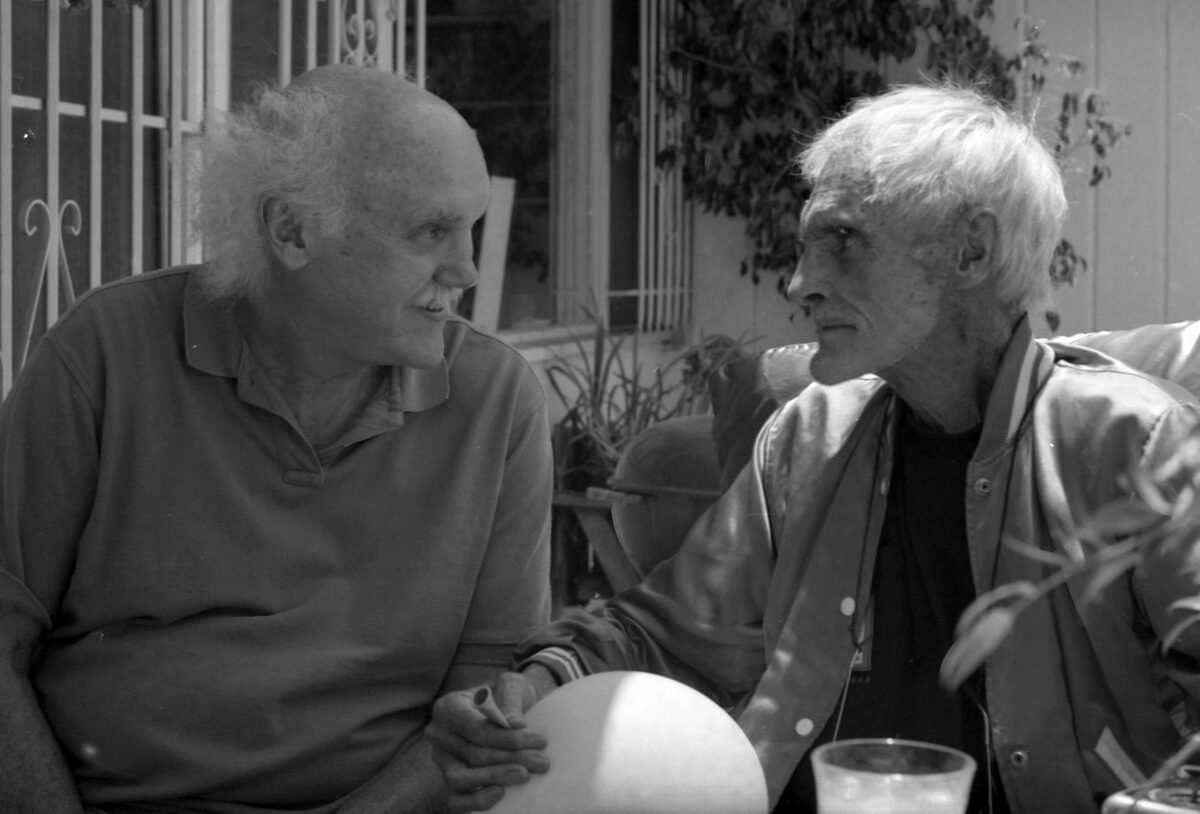
Ram Dass: Be Here Now and the Birth of Western Kirtan
In 1967, a dismissed Harvard psychology professor named Richard Alpert arrived in India, worn out by fame, psychedelics, and the search that neither had resolved. In the Himalayan foothills, a young American sadhu named Bhagavan Das led him to a saint wrapped in a plaid blanket: Neem Karoli Baba. The old man knew things about Alpert he could not possibly have known, and loved him in a way he had never been loved. Alpert stayed, practiced, and came home with a new name — Ram Dass, servant of Ram.
The book he assembled from that transformation, Be Here Now (1971), became a phenomenon — millions of copies, passed hand to hand, its hand-lettered pages introducing a generation to yoga, mantra, and the possibility that the love Ram Dass found in India was findable at all. It remains one of the most influential spiritual books America has produced.
But Be Here Now was only half the story. The other half was the satsang — the community that formed around Ram Dass and his guru. It was through Ram Dass's circle that a young Jeffrey Kagel traveled to India, met Neem Karoli Baba, and became Krishna Das; through the same lane that Jai Uttal found the temple courtyards where he first heard the names of God sung all night. For decades — through the Hanuman Foundation, the temple in Taos, and retreat after retreat — Ram Dass's gatherings were where Westerners learned to chant, long before "kirtan" needed no explanation at a yoga studio.
Ram Dass himself never performed kirtan; he practiced it, and he made room for it. His real instrument was the story — funny, self-deprecating, devastatingly honest — and after a massive stroke in 1997, the slower, softer teaching of his final decades on Maui may have been his deepest. He died in December 2019, at home, surrounded by chant.
Every Western kirtan gathering carries his fingerprints: the guru's photo on the harmonium, the storytelling between chants, the conviction that the singing is for love and not performance. The path from a Himalayan blanket to a chant festival in your city runs directly through Ram Dass.
Terms in the Glossary
Words from this page, explained in our A–Z reference.
Join the Kirtans.com Community
Receive occasional updates — thoughtfully curated devotional music, upcoming gatherings, artist announcements, new resources, and inspiration to support your Bhakti practice.
From This Article
Continue Reading
Guru Amar Das and the Song of Bliss
Converted at sixty-two by an overheard hymn, the third Sikh Guru made the free kitchen the tradition's front door — even an emperor sat on the floor to eat — and composed the Anand Sahib, the Song of Bliss that still closes every Sikh service in the world.
Guru Angad and the Alphabet Built for Song
The second Sikh Guru gave sacred song a script of its own. By standardizing Gurmukhi and collecting Guru Nanak's hymns in it, Guru Angad made sure the melodies would never lose their words — every Gurmukhi chant sung in the West today is written in his letters.
Guru Ram Das and the City of Nectar
An orphan who sold boiled chickpeas became the fourth Sikh Guru, founded Amritsar around a pool of nectar, and wrote the wedding hymns Sikh couples still circle to. Four centuries later, a chant bearing his name is sung in yoga studios around the world.