
Guru Amar Das and the Song of Bliss
Some lives in the history of sacred song begin with a single overheard melody. Amar Das was a devout Hindu trader in his sixties, a man who had made some twenty pilgrimages to the Ganges, when one morning he heard his nephew's wife, Bibi Amro, singing a hymn of Guru Nanak as she went about her work. The words undid him. Bibi Amro was the daughter of Guru Angad, the second Guru, and Amar Das asked her to take him to her father. He was sixty-two years old. He would spend the next eleven years in that Guru's service — and then, at seventy-three, an age when most lives are winding down, he would be named the third Guru of the Sikhs.
The water-carrier
The service that earned him the succession was almost comically humble. Every morning before dawn, in every season, Amar Das walked from Khadur Sahib to the river Beas and carried back a pot of water for Guru Angad's bath — an old man on a dark road, doing a servant's chore, year after year. One winter night he stumbled against a weaver's peg and fell, and the weaver's wife dismissed him as "Amru the homeless, who has no one." The Guru's reply became famous: this "homeless" one would become the home of the homeless, the honor of the unhonored. In 1552, Guru Angad passed over his own sons and invested Amar Das with the Guruship. The pattern held: in this lineage, devotion outranks blood.
First sit together, then meet the Guru
As Guru, Amar Das settled at Goindwal on the Beas and turned the community's inherited customs into durable institutions. The greatest of these was the langar — the free kitchen Nanak had begun and Mata Khivi had made famous. Amar Das made it a rule: pehle pangat, phir sangat — first sit in the row and eat, then come to the gathering. No one, high-born or low, reached the Guru without first sitting on the floor beside every other caste and creed, sharing the same simple food. In a society stratified to its bones, the kitchen was the teaching.
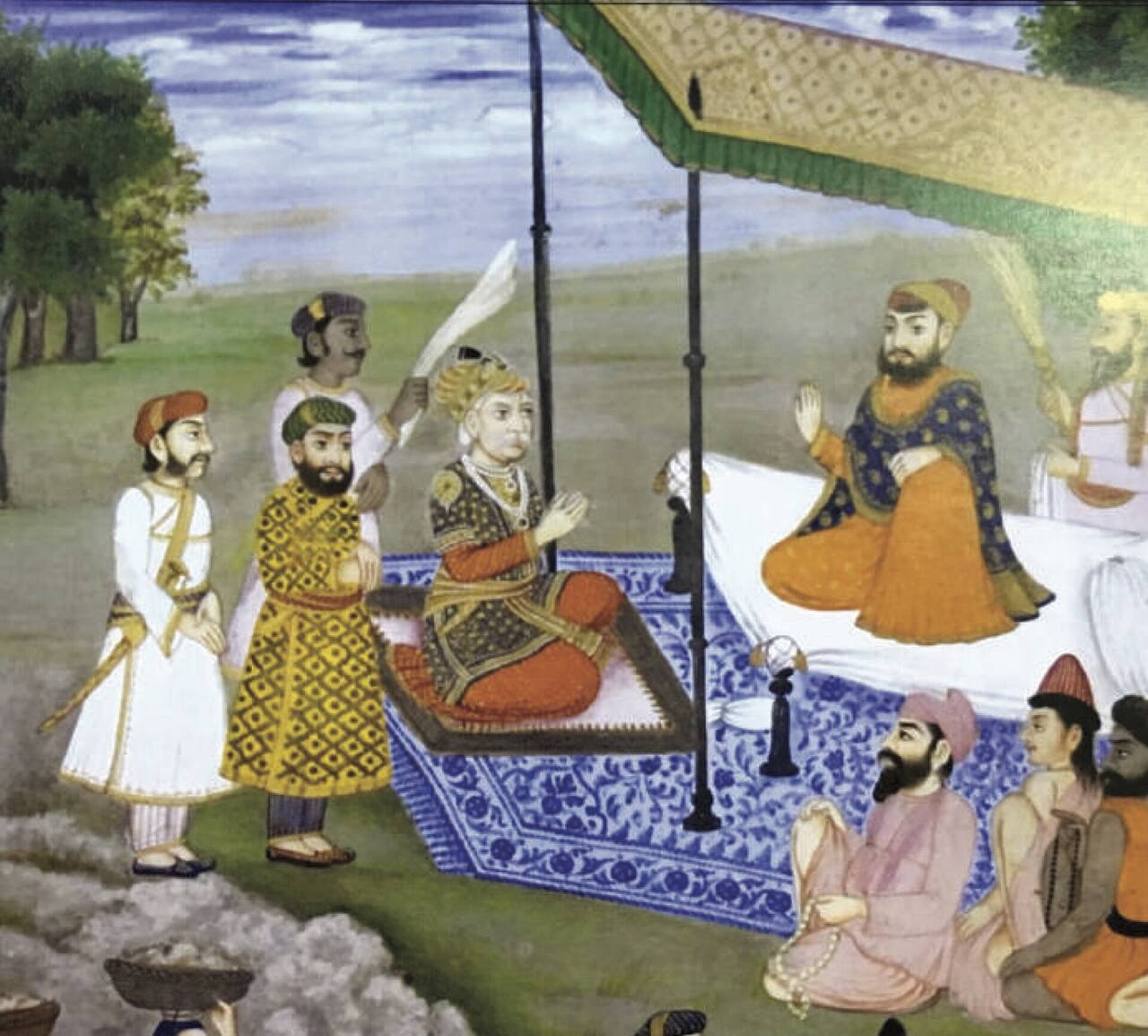
The rule bent for no one. When the Mughal emperor Akbar came to Goindwal in 1567 to meet the Guru, he too sat cross-legged in the pangat and ate with the pilgrims and the poor before a word was exchanged. An emperor on the floor, waiting his turn — there may be no better single image of what the third Guru built.
He built more. He organized the growing community into twenty-two manjis, teaching seats spread across the region, and appointed women among the preachers — centuries ahead of his time. He dug the great baoli at Goindwal, a stepwell of eighty-four steps, giving the young tradition its first pilgrimage center of its own. And he pushed hard against the social cruelties of his day: sati, purdah, caste exclusion. All of it flowed from the same conviction the langar embodied — that in the presence of the One, hierarchy is fiction.
The Song of Bliss
But the reason his name is sung every single day, in every gurdwara on earth, is a poem. In Raag Ramkali, Guru Amar Das composed the Anand Sahib — the "Song of Bliss" — forty stanzas on the joy that floods a life when it finds the true Guru: Anand bhaia meri maae, satiguru mai paaia — "Bliss has come, my mother, for I have found my true Guru." Tradition says he composed it in his nineties, on the birth of a grandson. It is the sound of an old man overflowing.
The Anand Sahib closes every Sikh service. Its stanzas are sung at weddings and at funerals alike — bliss, in this tradition, is not circumstantial. Nearly five centuries after it was written, it may be the most regularly performed piece of sacred music in the world, chanted daily as kirtan by millions, its shabads passing from trained ragi musicians to congregations who know every line. The whole ecosystem of Gurbani song that Western artists like Gurunam Singh and Nirinjan Kaur draw from carries the Anand Sahib at its center — the daily proof that in this lineage, doctrine and melody are the same thing.
The builder's bequest
Guru Amar Das led the community for twenty-two years and died in 1574, at ninety-five. Before he died he did what his two predecessors had done: he looked past his sons and chose devotion. The succession fell to his son-in-law Jetha — a man who had entered the household as an orphan selling boiled chickpeas, and who had served the Guru's family with the same uncomplaining steadiness Amar Das had once offered Guru Angad. Jetha would become Guru Ram Das, founder of the city of Amritsar, and the lineage's story would move from the stepwell at Goindwal to a pool of nectar. But the shape of the tradition — the kitchen at the front door, the song at the center, the row on the floor where emperors and beggars eat the same dal — is the third Guru's, and it has never changed.
The Sikh Kirtan Lineage · Part 3 of 7
Terms in the Glossary
Words from this page, explained in our A–Z reference.
Join the Kirtans.com Community
Receive occasional updates — thoughtfully curated devotional music, upcoming gatherings, artist announcements, new resources, and inspiration to support your Bhakti practice.
From This Article
Continue Reading
Guru Angad and the Alphabet Built for Song
The second Sikh Guru gave sacred song a script of its own. By standardizing Gurmukhi and collecting Guru Nanak's hymns in it, Guru Angad made sure the melodies would never lose their words — every Gurmukhi chant sung in the West today is written in his letters.
Guru Ram Das and the City of Nectar
An orphan who sold boiled chickpeas became the fourth Sikh Guru, founded Amritsar around a pool of nectar, and wrote the wedding hymns Sikh couples still circle to. Four centuries later, a chant bearing his name is sung in yoga studios around the world.
Guru Gobind Singh and the Song That Became the Guru
The tenth Sikh Guru founded the Khalsa, completed the Guru Granth Sahib with his martyred father's hymns — and none of his own — and then enthroned the book of songs as the eternal Guru. Kirtan has been the center of Sikh worship ever since.