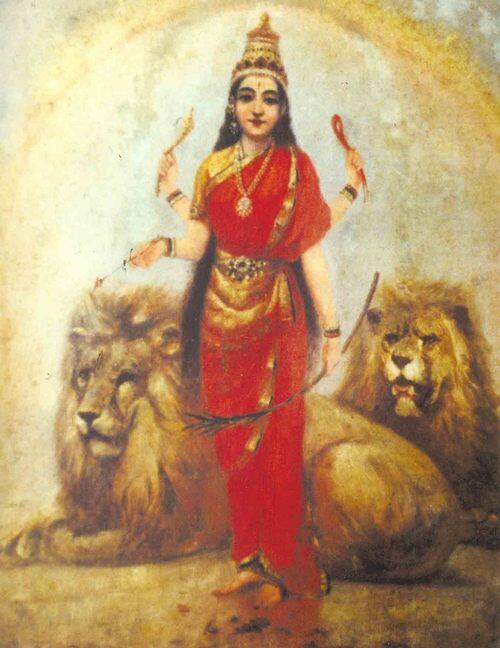
Durga is the Divine Mother in her radiant, protective, warrior form. Her defining story is told in the Devi Mahatmya: when the buffalo demon Mahishasura could be defeated by no god, the combined light of all the gods blazed forth as a single goddess. Each god gave her his weapon — Shiva his trident, Vishnu his discus — and riding a lion, she defeated the demon that no one else could face. Her name means "the invincible one," or "she who is difficult to approach."
The deeper teaching is that Durga's battle is an inner one: Mahishasura is the stubborn, shape-shifting ego, and Durga is the fierce compassion that finally cuts through it. She is not fearsome to her devotees — to them she is simply Ma, the Mother, and her fierceness exists entirely for their protection.
Every autumn, hundreds of millions celebrate her nine-night festival, Navaratri, filled with singing and dancing. In Kirtan, calling on Durga — or on the Divine Mother by any of her names — invokes shelter, courage, and the tender ferocity of a mother's love.
In Traditional Art
Durga is depicted as a beautiful golden goddess with eight or ten arms, each holding a weapon given by one of the gods, riding a lion or tiger. The classic image shows her calm-faced — utterly serene — even as she slays the buffalo demon Mahishasura beneath her. Her serenity in battle is the whole point: fierce action, peaceful heart.
In Kirtan
Kirtan to Durga — "Jaya Jagatambe," "Durge Ma" — is Mother-chanting: singers call out to the Divine Mother the way children call home. Chants to the Divine Mother in her universal form ("Jai Ma," "Adi Shakti") share this same heart. Durga chants often surge with rhythmic power, echoing her warrior energy, and are favorites during Navaratri.
Mantras Sung to Durga
Jai Ma
"Victory to the Divine Mother"
Jaya Ambe Jagadambe
"Victory to the Mother, Mother of the Universe"
Durga Mantra
"Salutations to Durga, the fierce and protective Mother"
Jaya Jagatambe Ma Durga
"Victory to Jagadamba, Mother of the Universe — Durga and Kali"
Sarva Mangala Mangalye
"Salutations to Narayani, the auspiciousness within all that is auspicious"
Hey Ma Durga
"O Mother Durga — a loving call to the fierce, compassionate Mother"
Adi Shakti
"A bowing to the Primal Power — the creative force of the Divine Mother"
Anandamayi (Om Anandamayi Chaitanyamayi)
"An invocation of the Divine Mother as bliss, consciousness, truth, and the Supreme"
Jaya Durge
"A victory chant to Durga, the fierce protective form of the Divine Mother"
Ya Devi Sarva Bhuteshu
"To the Goddess who abides in all beings as power — again and again, salutations to her"