
The Sacred Texts Behind Kirtan
Spend any time exploring mantras and you will notice the same sources appearing again and again. The Gayatri Mantra "comes from the Rig Veda." Asato Ma Sad Gamaya "appears in the Brihadaranyaka Upanishad." The path of devotion is "taught in the Bhagavad Gita." You don't need to be a scholar to chant — but knowing what these texts are makes every origin story come alive. Here is the beginner's map.
The Vedas: where sacred sound begins
The Vedas are the oldest sacred texts of India — four vast collections of hymns, chants, and ritual knowledge composed over three thousand years ago. Their names are the Rig, Sama, Yajur, and Atharva Veda. For most of their history they were not books at all: they were sound, memorized syllable-perfect and passed from teacher to student by voice alone. That is why the tradition calls them shruti — "that which is heard."
For chanters, this matters more than any date or doctrine: in the Vedic world, sacred sound itself is the practice. The Gayatri Mantra comes from the Rig Veda and has been chanted at sunrise for well over three thousand years; the Mahamrityunjaya Mantra, the great healing prayer to Shiva, is drawn from the Rig and Yajur Vedas. When a kirtan gathering opens with Om, it is sounding the syllable the Vedas call the seed of all speech.
The Upanishads: the questions underneath the chanting
Toward the end of the Vedic period, the emphasis shifted from ritual to inquiry. The Upanishads — the name means "sitting down near" a teacher — are intimate dialogues asking the deepest questions: What is the self? What is the Divine? Are they two things, or one? Their great answer — that the individual soul (atman) and the ultimate reality (Brahman) are not separate — became the heart of Indian spirituality.
Some of the most beloved chants in the Western kirtan world come straight from their pages. Asato Ma Sad Gamaya — "lead me from the unreal to the real" — is from the Brihadaranyaka Upanishad. Om Purnamadah, the meditation on wholeness, opens the Isha Upanishad. Even the Hare Krishna Maha Mantra first appears in an Upanishad — the Kali-Santarana — which teaches that in this age, singing the divine names is the simplest way through.
The Bhagavad Gita: the song that made devotion a path
The Bhagavad Gita — "the Song of God" — is a seven-hundred-verse conversation between Krishna and the warrior Arjuna, set on the eve of a great battle. Arjuna is paralyzed by doubt; Krishna's counsel to him became India's most beloved spiritual text. The Gita maps the great paths of yoga — knowledge, action, meditation, and devotion — and its warmest teaching is that bhakti, simple loving remembrance of the Divine, is open to everyone, in the middle of ordinary life.
That teaching is the seed of everything kirtan does. When a room full of people sings to Krishna — in the Hare Krishna Maha Mantra or Om Namo Bhagavate Vasudevaya, the mantra of surrender to the same Vasudeva who speaks the Gita — they are practicing exactly what Krishna describes: remembering the Divine with love, out loud, together.
Vedanta: the thread that ties it together
One more word appears constantly around chant and yoga: Vedanta, literally "the end of the Vedas." It is the school of thought built on the Upanishads and the Gita, asking what the self truly is and answering that it is not separate from the Divine. When Swami Vivekananda rose to speak in Chicago in 1893, it was Vedanta he carried west — opening the road that every later teacher of chant and yoga traveled.
You never need to read a single verse to sit down at a kirtan and sing. But the next time an origin story says a chant "comes from the Rig Veda" or "appears in the Upanishads," you'll know the map: the Vedas gave us sacred sound, the Upanishads gave us the questions, the Gita gave us devotion — and kirtan is what it all sounds like when it's sung.
The Sacred Texts Behind Kirtan · Part 1 of 2
Terms in the Glossary
Words from this page, explained in our A–Z reference.
Join the Kirtans.com Community
Receive occasional updates — thoughtfully curated devotional music, upcoming gatherings, artist announcements, new resources, and inspiration to support your Bhakti practice.
Continue Reading
The Story Scriptures Behind Kirtan: Epics, Puranas, and the Names We Sing
Ram, Sita, Hanuman, Krishna — the names sung at almost every kirtan come from stories. Part 2 of our guide to the sacred texts maps the story canon: the two great epics and the Puranas, and how their heroes became the heart of the chant.
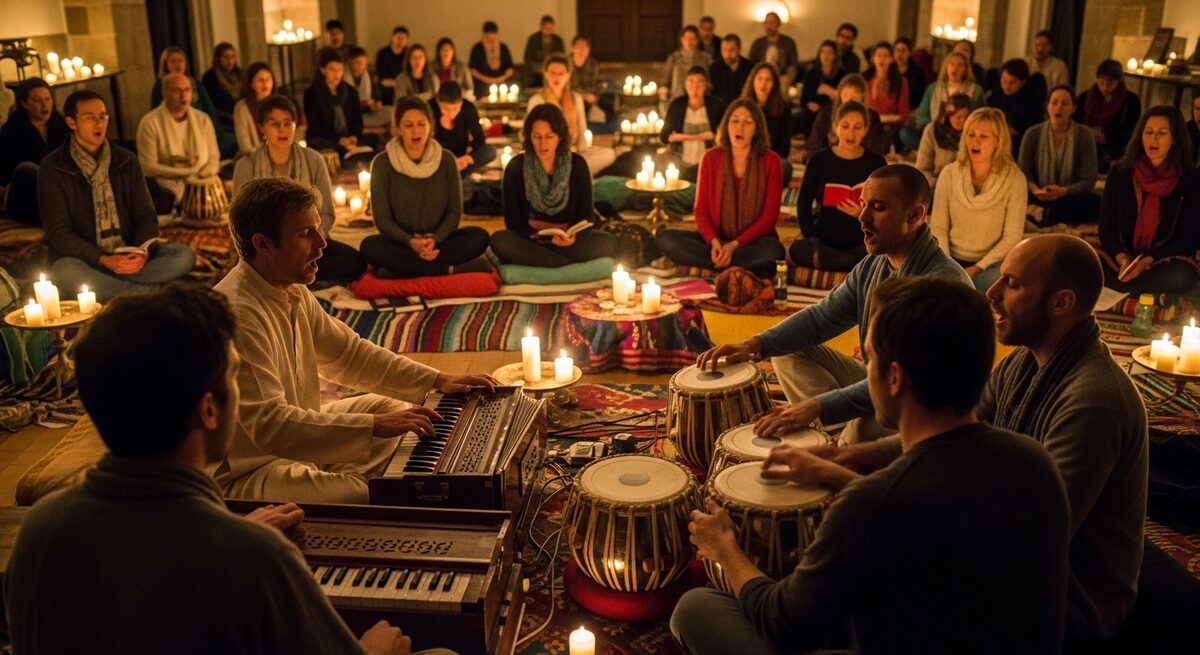
What to Expect at Your First Kirtan Gathering
Walking into your first Kirtan can feel mysterious if you don't know what to expect. Here's a friendly guide to help you feel comfortable, welcome, and ready to open your heart.
What Is Kirtan? A Beginner's Introduction to Sacred Chanting
Kirtan is a devotional practice of call-and-response chanting, often rooted in Bhakti yoga and the mantra traditions of India. But what exactly happens when a group of people sit in a circle and chant together — and why does it feel so transformative?